

by Andrea Aleksandrova
Andrea advocates for women who have suffered domestic abuse and betrayal by male intimate partners. Her Facebook account is AndreaAleksandrova. Update Dec 2025: For reasons of safety Andrea hid her personal FB account some time ago, but she continues her advocacy work at Survivor Story.
Over the past week there has been a Twitter war between Sheila Wray Gregoire and Patrick Miller from the Truth Over Tribe podcast. I’ve been watching this exchange with interest as I have had my own run-in with Sheila. The conversation revolved around The Great Sex Rescue research done by Sheila, Rebecca Lindenbach, and Joanna Sawatsky (hereafter referred to as “Sheila’s” research). My own run-in with Sheila also involved her research, and I want to have an in-depth discussion about Sheila’s research and about claims she is making. I would also like to express my concerns with how justice-loving people are responding.

In December 2021 Sheila was heavily advertising her and Keith Gregoire’s new book, A Good Guy’s Guide to Great Sex, and many conversations were taking place on social media. I made what I thought was a very innocent comment on a Facebook post, suggesting that before we take Sheila’s new data as fact that we make sure to compare it to other data that exists and make sure we base our conclusions off of the whole picture rather than considering Sheila’s new research in a vacuum. As a victim advocate who specializes in supporting betrayed partners of sex addicts, I know a thing or two about pornography statistics. Sheila’s men’s survey states that “only 6.5 percent of men were currently using porn on a regular basis. . . . 16.7 percent have intermittent binges, and another 26.5 percent use it rarely” (1). Other porn statistics available contradict these findings. For example, according to the “The Porn Phenomenon” done by the Barna Group, “among teen and young adult men, 81% ever seek it out and 67% at least monthly. Among men ages 25-plus, the comps are 65% and 47” (2). According to a Proven Men study done in 2014, 54% of born-again Christian men view porn at least once a month (3). Additionally, there are multiple peer reviewed studies that show that men are using pornography at extremely high rates, ranging in the 91-98% range (4). Some of these studies show that religious men consume pornography at exactly the same rates as non-religious men (5). Given the extremely low rates of porn usage among men in Sheila’s data, I have questions and do not believe her data should be taken as gospel truth but should be considered in light of all the other available data. I have never wanted to throw Sheila’s data out, but I do not think it is academically sound to consider her data alone in a vacuum.
As soon as I suggested that maybe we should consider Sheila’s data in light of the other data that does exist, Sheila attacked me. She publicly named and attacked me in a Facebook Live on Sarah McDugal’s Facebook page (that has since been deleted). Sheila said that if I critiqued her stats that I was supporting misogynists and people like Shaunti Feldhahn. This, I believe, is the crux of the whole Twitter war we saw this past week between Sheila and Patrick Miller. For whatever reason, Sheila cannot handle any critique of her research whatsoever without interpreting it as a personal attack.
Here’s how it went down: Patrick interviewed Josh Butler on the Truth Over Tribe podcast (6). In March, Josh had released an excerpt from his upcoming book, Beautiful Union, where he compared sex to salvation and likened a man’s semen to the Holy Spirit being poured into a woman’s hospitable womb (7). What Josh wrote was truly dreadful and created very justified outrage. Barbara Roberts wrote this piece, which I feel captures well the trauma Josh’s writing inflicted on numerous Christian women: An abuse survivor’s poetic critique of Josh Butler’s “Beautiful Union”
I want to make it clear that I do not support Josh Butler. As a victim advocate, I believe that the brand of Christianity he promotes is misogynistic and perpetuates abuse. However, the Twitter storm last week between Sheila and Patrick was not about Josh Butler’s misogyny or the fact that Patrick platformed him. It was about Sheila Wray Gregoire’s research. I am curious how many people actually took the time to listen to the podcast interview and how many of Sheila’s followers simply reacted in outrage. To shed some light on this, I have transcribed the relevant parts of the podcast:
In the podcast (44 minutes in), Patrick Miller quotes a tweet from Sheila where Sheila critiques Josh’s book, Beautiful Union. He also mentions that Josh did quote Sheila positively in his book. After reading the quote, Patrick says: “I think these are some very legitimate and serious questions, and I know it’s probably impossible to respond to everything in here. I think we have responded actually in some ways to some of the concerns here, but how would you respond to the critique?”
Josh: “Great question. So first an important starting point is that Sheila and I share a common concern to address sexual abuse and the mistreatment of women. I address abuse strongly in the book as I have throughout my ministry. I agree that there’s a need for care in how Christian authors teach about sex. In the editorial process for this book we had multiple layers of sensitivity reviews from survivors of sexual abuse and a professional female sensitivity reviewer, and the book was received astoundingly positively. I’ve received many messages from survivors recently who said, ‘I don’t get the critique. I read the book, and it didn’t have that tone or message at all. I loved it.’ That’s not to discount one perspective, but to say that there’s not just one monolithic perspective.”
Patrick: “If I could just interject here for a second. I agree there’s rarely a monolithic perspective of ‘all women think X’ or ‘all men think X’ about any different topic. And that has been one of my challenges interacting with this. Just a small example of that — I saw one example of this on Twitter, and I’m not going to name names, but there was a well-known author, counselor-type guy and he was critiquing your book saying, ‘We need to listen to women!’ and someone responded to him, who is a relatively well-known PhD in counseling, so in the relevant areas, and started saying, ‘Hey, this isn’t a monolithic view,’ and he goes on to argue with her on Twitter, when in the previous tweet he said, ‘We need to listen to women!’ and it highlighted for me when we start talking in monolithic terms we can know that the argument isn’t being totally honest. However, as Sheila says in the tweet, her views are based on research, and I think you kind of have to respond to that. I mean, you might have your argument, but if the research goes the opposite direction, I think she kind of wins the ‘case.’”
Josh: “Yes, so that brings me to my second point, which means we have to clarify what we mean by ‘research.’ Shaunti Feldhahn is a Harvard-trained researcher who’s been doing qualitative research on sex and marriage for decades and writing on this as a Christian, and her books have sold millions of copies. Her new book is amazing, by the way, Secrets of Sex and Marriage with Dr. Michael Systma. But Sheila has also critiqued Shaunti with the same critiques as having damaging, male-centric teachings, which even escalated to disparaging personal comments about Shaunti and her family. And Shaunti responded in a public statement, and one of her points was this: She said, ‘The survey that forms the basis of Sheila’s book appears to be primarily of women with a particular point of view. In a survey of 20,000 respondents, close to half of respondents appear to be Sheila’s existing followers who had heard multiple times from her that those teachings were damaging. Just as concerning, many other respondents were recruited with a leading message, such as, ‘Ever feel like the Christian sex and marriage advice we get is just kind of, well, off somehow? Let’s change that!’ Shaunti goes on, ‘It is contrary to good research practice to recruit a sample with an existing viewpoint and which is primed to respond in a certain way and then ask them, ‘How do you feel about this viewpoint?’ There is value in hearing from those people and those viewpoints, but the results must be viewed as results from Christian women of that viewpoint rather than Christian women as a whole.’ End quote. I like how she says these are viewpoints we need to listen to. And we do. I do. But we also need to be wary of thinking these surveys represent Christian women as a whole.”
Patrick: “I honestly hadn’t read that from Shaunti before, and so I’m kind of embarrassed to admit I was rather unaware of some of the research practices that went into this, and while I am not a researcher, I think anyone who is not can understand why there might be some issues with the way they went about getting the research, but I appreciate what Shuanti said which is it doesn’t mean we throw the information out. Right? It’s still valuable. We just need to know how is it valuable and who is speaking in this particular survey. But going back to Sheila’s tweet, it wasn’t just saying, ‘Hey, my views are rooted in research,’ she was also talking about the fact that you use language of hospitality in your book, which can suggest that women have a duty of hospitality, a duty to give themselves to their husbands, and I know we’ve already discussed this some, but I just want you to speak to that.”
Josh then goes on to discuss what he means by “hospitality”. Now if I were to critique this exchange, I would not be focusing on Sheila’s research or on how Patrick or Josh treated her research. To be honest, I find Shaunti’s perspective compelling (although I do have concerns with the content of Shaunti’s books). Shaunti’s concern with Sheila’s research is one I also have that may explain why Sheila’s pornography statistics are so much lower than other studies. Regardless, I wouldn’t be focusing on this. Instead, I would be focusing on Josh’s claim that he addresses abuse strongly in his book and his claim that his book had multiple sensitivity reviews from survivors of sexual abuse and that many survivors loved his book. However, Sheila, it seems, only had ears for her research. Over on Twitter, she tweeted:
 Does this sound accurate? Did Josh ever say in the interview that he had done his own research?
With this inaccurate statement, Sheila’s Twitter mob was activated. And yes, I do believe Sheila has a Twitter mob. I experienced Sheila’s mob when I critiqued her research a year-and-a-half ago. I am still dealing with the backlash of her mob a year-and-a-half later. For this, I feel sorry for Patrick. When Sheila’s mob is activated, truth isn’t what matters. Protecting her research is what matters.
Sheila then shared a tweet from Dr. Beth Allison Barr, where Dr. Barr says Patrick and Josh can’t challenge Sheila’s research because it’s been peer reviewed:
[UPDATE by Barbara Roberts, 8 June: Dr Barr has now deleted the tweet shown in the screen shot below. Barbara Roberts challenged Dr Barr’s erroneous statement that Sheila’s research has been peer reviewed. That led to a twitter war that lasted days. Eventually, Dr Barr deleted her erroneous tweet.]
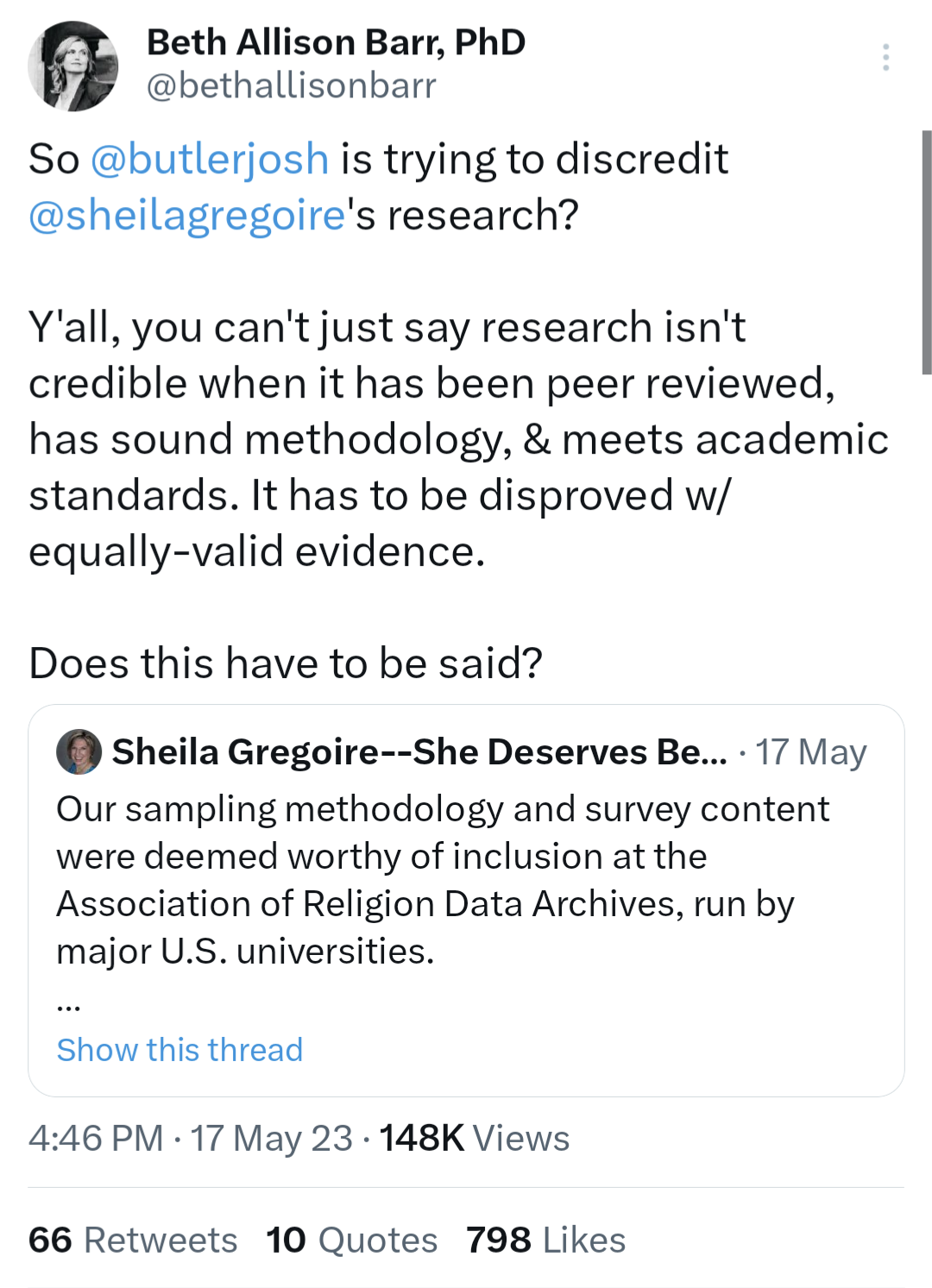
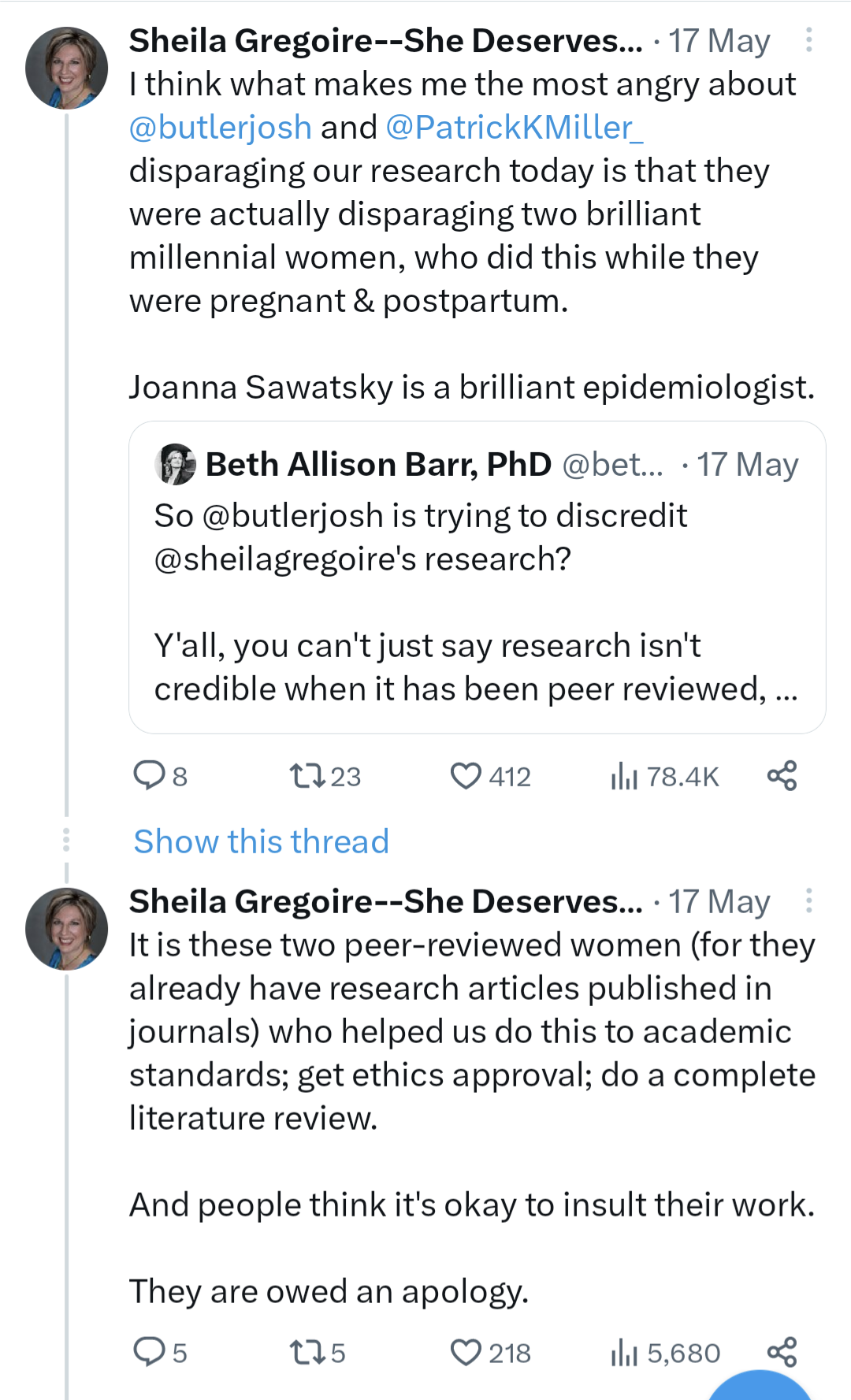
Problem being, Sheila’s research is not peer reviewed. Their research is housed at The ARDA, which is a data archive (8). This is not peer review. Their research also passed ethics approval, but ethics approval is also not peer review. It is a part of the research process that ethically protects both the researcher and the research participants (9).
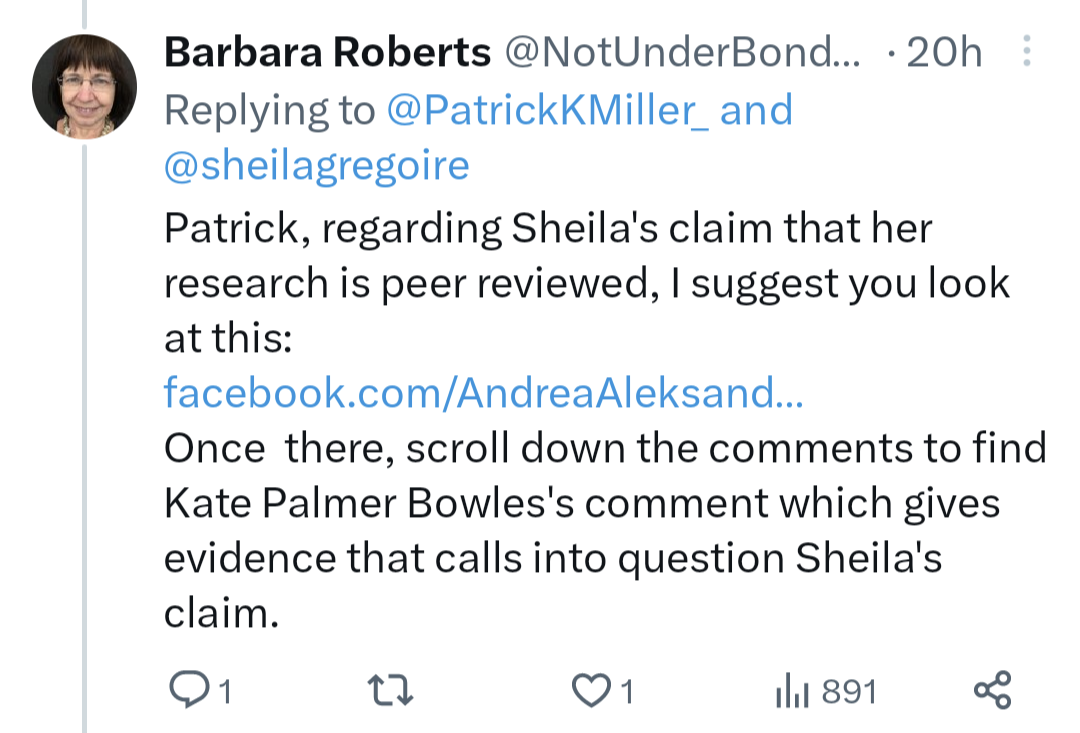
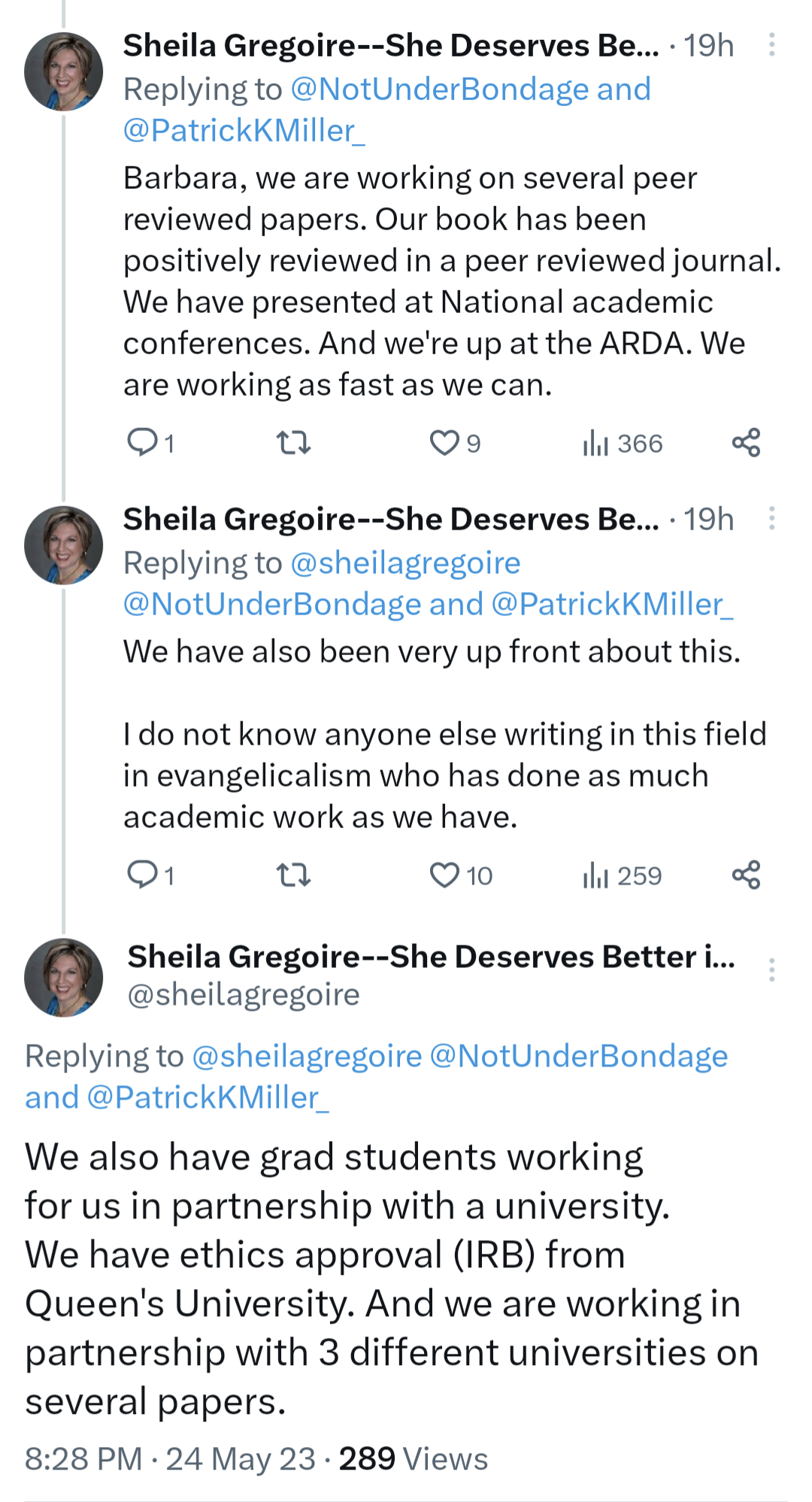
Working on peer reviewed papers and actually being peer reviewed are two very different things. Claiming your research is peer reviewed when it’s not is not “being up front.” It’s misleading and deceptive. The work Sheila, Rebecca, and Joanna have done is commendable, but their achievement is tarnished when they are willing to mislead others about their work. When Sheila says their work has been “positively reviewed in a peer reviewed journal,” what she means is that it has been cited in someone else’s peer reviewed work (10). Once again, this is not peer review. Thing is, Sheila’s research has not been peer reviewed (yet), so we do not know if it has sound methodology or meets academic standards.
However, let’s say Sheila’s research does pass peer review. That does not suddenly make it beyond criticism or critique. As an intimate partner victim advocate, I am well aware that there are multiple studies in the domestic violence movement that contradict one another. We have studies that say that women severely assault men at higher rates than men severely assault women (11). Then we have other studies that say intimate partner violence is a strictly gendered crime where the vast majority of perpetrators are male and victims are female (12). Evan Stark spends an entire chapter in his book, Coercive Control, wrestling with these statistics (13). Statistics are not meant to be above question. They give us information about our world, but they usually should not be taken as concrete truth. The conclusions we form from research are complex, and we can go wrong very easily. For example, if I were to take one study in a vacuum that says women severely assault their male intimate partners at higher rates than men severely assault their female intimate partners and ignore all the other research that exists, I would logically conclude that women are perpetrators more often than men. However, this would not be accurate because I would be missing other data that tells me that female victims of domestic violence often use defensive violence to protect themselves from their abusive male partners and are frequently incorrectly identified as perpetrators (14). We are not being evidence-based if we say we cannot critique Sheila’s research, even if it passes peer review, and we are not doing women any favors if we whip up a mob rather than engaging in civil academic discourse.
Sheila’s Twitter storm lasted for a few days until Patrick issued what I believe was an unnecessary apology (although I do believe his apology shows character). I do think “Twitter mob” is a good label for the backing Sheila receives. Josh Butler’s misogynistic theology is bad. Patrick Miller’s decision to platform Josh is questionable, but Sheila’s inability to hear or receive any academic criticism of her research is intolerant, and the Twitter mob that amasses behind her is, quite frankly, terrifying. At some point I hope all the justice-loving Christian souls out there would examine themselves and ask if, they too, are not becoming a part of the problem. I would call Josh Butler’s theology abusive. I would also say that the conversation between Josh and Patrick was fair and respectful, and it is perfectly fine and even necessary for people to be able to critique Sheila’s research. That is what should happen with research. Things get scary when we say, “No, you cannot think this way or ask these questions,” and then attack others and shut down any dissenting views. At that point, I’m afraid we are simply bullies ourselves running our own abusive machine.
References
- Gregoire, Sheila and Keith, The Good Guy’s Guide to Great Sex, p. 148 Kindle edition, Zondervan, 2022.
- The Porn Phenomenon
- Pornography Survey Statistics
- Latest Pornography Statistics, old and newer
(Special thanks to Kate Palmer Bowers at makemyburdenlight.com for researching and creating this document.) - Self-Perceived Effects of Pornography Consumption Among Heterosexual Men
- The Sex Book That Broke the (Christian) Internet with Joshua Butler
- Sex Won’t Save You (But It Points to the One Who Will) [Internet Archive link]
- Sexual Satisfaction and Function Survey
- What is Ethical Approval
- References: Clinical Considerations of the Evangelical Purity Movement’s Impact on Female Sexuality
- The 1992 and 1995 National Alcohol and Family Surveys [USA].
- Domestic abuse is a gendered crime
- Stark, Evan, Coercive Control: The Entrapment of Women in Personal Life, chapter 2, Oxford University Press, 2007.
- Some Issues to Consider When DV Survivors Are Charged with DV-Related Crimes
Update 3rd June 2023 (added by Barbara Roberts): I have added two links to this post, so readers can click and see for themselves two of the tweets by Beth Allison Barr and Sheila Gregoire which are mentioned in this post.
***
Further reading
Posts (articles) by Barbara Roberts which you might like to peruse for further reading.
Why I publish my concerns about various abuse advocates
Society has been hoodwinked by men who abuse their female intimate partners
Discover more from A Cry For Justice
Subscribe to get the latest posts sent to your email.


I witnessed that! As someone who agreed with Shelia and disagreed with your comment, I was shocked by how Shelia responded! Disagreement isn’t a personal attack and her reaction was over the top aggressive and defensive. It’s unhealthy to cultivate an environment where debate is not tolerated.
LikeLike
Jess,
You wrote (28th May 2023):
(The word “always” in brackets added by me.)
That. I added the word “always” to clarify that sometimes disagreement is a personal attack. While what you wrote, Jess, was clear, what you wrote in your phrase “disagreement isn’t a personal attack” might be taken by some people as a statement, as a “rule”.
LikeLike
Adding on to my own comment (28th May 2023)….
From Andrea Aleksandrova’s Guest post:
That.
From Andrea Aleksandrova’s Guest post:
That.
From Andrea Aleksandrova’s Guest post:
(The phrase “many people” and the word “their” in brackets added by me.)
That.
From Andrea Aleksandrova’s Guest post:
That.
From Andrea Aleksandrova’s Guest post:
(The modification of the quote from Andrea Aleksandrova’s Guest post was done by me, including the addition of the phrase “a viewpoint” in brackets.)
That.
From Andrea Aleksandrova’s Guest post:
(The name “The Association of Religion Data Archives” in brackets and the link to The Association of Religion Data Archives were added by me.)
That.
From Andrea Aleksandrova’s Guest post:
That.
From Andrea Aleksandrova’s Guest post:
(The word “that” in brackets added by me.)
That.
From Andrea Aleksandrova’s Guest post:
That.
From Andrea Aleksandrova’s Guest post:
(The word “anyone” in brackets added by me.)
That.
From Andrea Aleksandrova’s Guest post:
(The phrase “and others” in brackets added by me.)
That.
LikeLike
Excellent post. I have noticed the character issues of Sheila Gregoire as well, and the terrifying mob of fans that defend her before using their critical thinking skills. I saw that the apology was published after Sheila Gregoire threatened him with legal action. This is bullying. This is not being able to take critique in the same way she dishes it out to others. That is not good character or integrity. I feel that his apology was made out of fear that Sheila elicited in him.
I was also highly disturbed to read her email following his apology, further smearing him and sitting on her throne of self-righteousness. This is not healthy character at all. I have seen her claim victim advocacy while ridiculing and attacking victims to protect her own ego. Maybe someday, her fans can be appreciative of the good things she has done, while letting go of their idol to use their discernment.
Appreciative of this post, thank you, Barbara.
[Paragraph break added to enhance readability. Editors.]
LikeLike
Thanks for going after the truth. I know it’s hard to do. I appreciate it.
LikeLike
This is a great post by Andrea. Very informative and well-reasoned. There is no anger only facts and sources. It is the sort of response neither author wants, I’m sure.
This saga has prompted many thoughts for me. Including about my mother.
My mother was a saint. Or so many people thought. I didn’t. Behind closed doors, she could be a real Piece Of Work!
Regarding arguing, she once said to me, “Once the other person gets angry, you win!”
And that is what she did. Her “arguing” consisted of finding the right approach to make whomever she was “arguing” with angry.
She had a number of approaches. Mostly calm but they included lying and insults. If needed, she could raise her voice claiming to be offended or resort to simple name-calling. Whatever it took to get the other person angry.
Readers are getting angry at Josh and Sheila. They claim rightly that these two are different but, nevertheless, they are both managing to get people angry. I see a commonality between their words. They are both authors, after all, and want to sell books. How do you sell books?
Back to my mother and back in time, I found it was better to ask myself HOW my mother was getting me angry rather than asking or reacting to WHAT she was saying. In other words, to focus on how she was behaving rather than on what she was saying. “What approach was she using this time?”
LikeLike
Sheila and Josh are both managing to get people angry. Spot on, James!
How is Josh managing to get people angry? By selling a twisted vision of sex and claiming it is “God’s vision of sex”. By teaching that male orgasm is a ‘sacrificial offering’, thus sacralising semen, etc., etc.
How is Sheila managing to get people angry? By making false claims about her research, bullying women who challenge her, and weaponising her numerous followers to pile on those she is angry with.
I know I’m saying nothing new here.
James’s mother was being uncharacteristically honest when she told him, “Once the other person gets angry, you win!”
LikeLike
I read the archived Butler article, “Sex Won’t Save You” and it displays that ‘social tone deafness’ again.
It reads more like Mills and Boon than theology. It’s just ‘off’!
LikeLike
James wrote (31st May 2023):
For those who might be unfamiliar with Mills and Boon [Internet Archive link]:
It’s also worth reading the information under the heading Critical opinion on the Wikipedia page linked to above….
LikeLike
I have added two links to this post, so readers can click and see for themselves two of the tweets by Beth Allison Barr and Sheila Gregoire which are mentioned in this post.
LikeLike
Finding Answers,
Knowing you like to read and research, I thought you might be interested in the Culture Reframed website.
Barb received a recommendation from Andrea Aleksandrova for Culture Reframed. I read through parts of it — I could’ve easily spent the rest of the day there! 😊 And in my reading through parts of the website, I saw Culture Reframed had some reports that were by (in some way, I didn’t read the details) Walter DeKeseredy.
I’ve added Culture Reframed to our Resources.
LikeLiked by 1 person
Thank you, Reaching Out. 😊
You wrote (9th June 2023):
That. 😊
And I’m adding some links from Culture Reframed that I Internet Archived.
This link is the page that appears when you click on their menu The Crisis: The Crisis [Internet Archive link]
You wrote:
And here are links to some of the reports on Culture Reframed that are written by Walter DeKeseredy.
Domestic Violence: The Contribution of Contemporary Pornography [Internet Archive link]
Understanding the Harms of Pornography: The Contributions of Social Scientific Knowledge [Internet Archive link]
Secret Connections: Male Collegial and Professional Contact Sports, Pornography, and Violence Against Women [Internet Archive link]
And here are links to some of the facts sheets:
Culture Reframed: Solving the Public Health Crisis of the Digital Age [Internet Archive link]
Culture Reframed: Parents Program [Internet Archive link]
Culture Reframed: The Problem [Internet Archive link]
Culture Reframed: Pornography Fact File: Mental Health & Addiction [Internet Archive link]
Culture Reframed: Resources: for Parents of Teens [Internet Archive link]
Culture Reframed: Compose Yourself [Internet Archive link]
Culture Reframed: Fact Sheet on the Harms of Pornography [Internet Archive link]
And here is one of the Culture Reframed articles:
Fighting Artificial Intelligence with Parental Intelligence: Protecting Your Kids from Deepfakes and Other AI-Generated Pornography [Internet Archive link]
LikeLike
Thanks, Finding Answers! What a deep diver you are! I appreciate your giving those links here.
LikeLike
Reaching Out — I “second” your enthusiasm about the Culture Reframed website. I moseyed on over there yesterday, spent ~2 hours, but also “could’ve easily spent the rest of the day there!”
LikeLike
In the last 24 hours, Sheila has said on Twitter “Our current research is not peer reviewed.”
LikeLike
Barb,
Thank you for including this tweet by Sheila Gregoire where she tweeted:
When I read this tweet you included, Barb, I laughed (and not in a positive way). Sheila Gregoire is twisting words as badly as many “Christians” twist Scripture. And there are many examples of Scripture-twisting in many different places (“church”, books, the internet, etc.). And many of those who twist Scripture are abusers. I’m not saying Sheila Gregoire is an abuser, nor saying some of what she writes isn’t good….but I would ask if Sheila Gregoire is acting in a Christ-like manner.
Quoting from Sheila Greqoire’s website Sheila Wray Gregoire [Internet Archive link] (she has at least one other website):
Rather copy-and-paste what Jess and I have already written, all the reader needs to do is read Jess’ comment of 28th May 2023, followed by my two replies (also of 28th May 2023, one to Jess, and one that adds on to my reply to Jess).
I’ll let the reader make up their own mind about Sheila Wray Gregoire….
LikeLike
LikeLike
LikeLike
Ms. Wray Gregoire’s descent into special pleading, “… disparaging two brilliant millennial women, who did this while they were pregnant & postpartum”, is weird and unprofessional. It’s what a person who has lost the argument on the facts does.
Opening with, “Don’t you dare question me!” and ending with, “Meanies, meanies, attacking a pregnant woman and a baby!!!!” is not persuasive in the way she seems to think.
She does not appear to realize that this kind of thing reinforces the very questions and concerns about the validity of her research that she’s trying to prevent.
LikeLiked by 1 person
Thank you for your comment, Princesa. It sounds like you have legal training or are an experienced debater. Special pleading — that’s exactly the tactic Sheila used in her tweet to Patrick Miller.
LikeLike
For the last 36 hours I’ve been in a massive Twitter war about this blog post. I tweeted some of what Andrea said in this post, and many many people on Twitter including Sheila Gregoire and her team have been disagreeing with me and telling me I’m wrong and I have a hidden agenda. Today, Andrea re-opened her Twitter account and has been contributing to the conversation. It’s been hectic, but it’s dying down now.
I’m saying this here in order to
a) explain why the other parts of my Josh Butler series have not yet come out, and
b) in case any of my blog readers are interested in what Sheila et al are saying about me and how Andrea and I and @Makemyburdenlight are responding to the push-back.
LikeLike
Barb,
You wrote (4th June 2023):
Seriously??? I’m not questioning what you wrote, Barb….it’s REALLY hard to convey the tone of voice I’m using for the word “seriously”….especially as the word “seriously” is used with so many different tones of voice….and I’m not going to research the internet just to try and find an audio clip that matches — especially when I suspect readers are most likely to already know what I mean. 😊
And I wonder….do the many many people on Twitter including Sheila Gregoire and her team have their own hidden agenda?
LikeLiked by 1 person
Over time, I have come to the view that many advocates and many theologians who are speaking about abuse, and many of their followers, have hidden agendas.
I also think every person on this planet has been traumatised in some way(s). So everyone has trauma wounds that are not yet fully healed.
Hidden agendas might spring from trauma wounds. Processing trauma wounds is often painful… so we shy away from doing it, and when shying away, hidden agendas can (subconsciously) seem logical and “useful” to us because we think that we know how to solve the problem of our pain.
Sorry, that was a bit rambling. Maybe I haven’t well-articulated what I mean.
LikeLike
Barb,
You wrote (5th June 2023):
If I re-write what I quoted from your comment, Barb, were you trying to suggest that it’s possible some of the advocates, some of the theologians, and some of their followers might have known or unknown trauma wounds that might be consciously or subconsciously causing their hidden agendas?
LikeLike
Near the end of that Twitter war, Beth Allison Barr tweeted something to me which she has now publicly apologised for. Here are the screenshots and links.
see this on Twitter
see this on Twitter
see this on Twitter
see this on Twitter
LikeLike
Barb,
Thank you for including the tweets in your comment of 30th June 2023. 😊 In my reply, I’m intentionally not doing what I normally do, which is to include many quotes from other places (posts, comments, tweets, etc.).
In Beth Allison Barr’s tweet where she says she was tired and bewildered — using “tired and bewildered” is an excuse (sometimes tired and bewildered is the truth, and sometimes it’s just an excuse). In this case, I think Beth Allison Barr’s use of “tired and bewildered” is an “excuse”.
And if readers read the entire exchange, they’ll notice that Beth Allison Barr is making her Twitter account private — perhaps in this case “private” would be more accurate considering she mentions the actual number of people who follow her (perhaps a small number compared to many celebrities, but the number of her followers is still significant). In the same tweet, right after Beth Allison Barr mentions the number of her followers, she appears to be making more “excuses” (about why she is making her account private).
From the last tweet of Beth Allison Barr’s that Barb included in her comment:
(The name “Twitter” in brackets was added by me, and the bold was done by me.)
Should that be honest or “honest”? And will the writing be good writing or “good writing”?
LikeLike
My sister and I have read this post and it is spot on. Thank you for writing it, Andrea, and thank you for posting it, Barbara. I’ve observed some of the Twitter war going on. The irony is that those giving Barbara and Andrea grief are validating their stated concerns.
LikeLike
I found Sheila’s comment about [paraphrasing] “two millennial women doing this research while pregnant and postpartum” strange. And? This gives them more credibility because….?
I initially followed Sheila because I admired the way she pointed her readers back to Scripture, even when I didn’t agree with her conclusions. She always made me think and a lot of her content helped me tremendously when my marriage was going badly. Now she seems to hold the numbers, specifically HER numbers, above all else including the Bible. I can’t in good conscience follow or recommend her work anymore for this reason.
LikeLike
Anon,
You wrote (25th August 2023):
(The word “paraphrasing” in brackets was in the original comment. The word “is” in brackets was added by me, and the bold was done by me.)
That.
LikeLike
Thank you, Anon. I agree with you that Sheila Gregoire is holding HER numbers (from her non-peer-reviewed research) above everything else including the Bible.
I am very concerned that Sheila is misleading her followers into believing that porn is not always dangerous and that sex addiction is not as serious as it actually is.
Sheila has very little understanding of Coercive Control, and no understanding of how victims are always resisting abuse. She is ignorant about Response-Based Practise and she is resistant to learning about it.
I think Sheila Gregoire is dangerous, and all the more so because she seems to be advocating for women who have suffered under purity culture and spiritual abuse. She is a very skilled self-promoter, and her reach is massive. Many other so-called advocates are buddying up with her to increase traffic to their own platforms.
LikeLike
Hi Anon,
Although it’s included as a link under Further reading on the post titled Thursday Thought — Honouring Resistance by Dr. Allan Wade that Barb provided the link to in her comment when you click on her phrase how victims are always resisting abuse, you might be interested in a direct link to the 34-page booklet from the Calgary Women’s Shelter, Honouring Resistance: How Women Resist Abuse in Intimate Relationships.
LikeLike
In fairness to the porn comment, Sheila has written quite a few times about the danger and addictive nature of pornography. That said, her numbers (I’m REALLY curious how she got them because talk about an anomaly) might encourage men and women alike to see the problem as less serious and widespread than it is.
Yes, I noticed a change in Sheila’s approach and tone when “The Great Sex Rescue” really gained traction. Her blog and social media became much more focused on herself and her research than the Truth of Scripture.
I have many friends who are big fans of Sheila’s, and I’ve observed them becoming increasingly strident and disparaging when talking about the church / their churches, marriage in general, and their own marriages specifically. They’re quick to see “abuse” (putting this in quotes because their definition is so broad it loses nearly all meaning) and are quite resistant to anything that doesn’t fall in line with Sheila’s numbers or teaching. This isn’t Sheila’s fault, but it’s a distressing pattern.
This really saddens me. As I said above, Sheila’s ministry blessed me greatly when I needed it. I still refer to some of her older work but no longer follow her closely.
LikeLike
Hi Anon. I don’t have many friends who are big fans of Sheila’s. But I hove observed online many women who follow Sheila becoming increasingly strident and disparaging when talking about the church / their churches, marriage in general, and their own marriages specifically. I have observed these women being “quick to see ‘abuse’ and quite resistant to anything that doesn’t fall in line with Sheila’s numbers or teaching.”
I am not sure I agree with you that this isn’t Sheila’s fault. Certainly the women doing that share some of the blame, but I think Sheila bears a lot of the blame for it. Sheila is cultivating and prioritising that attitude, and modelling it in her own behaviour. She is being seen as a leader by many.
In my view, Sheila is a hireling, hired not by a church but by herself and promoting herself without regard for how what she teaches and models is misleading and dangerous. Leaders bear a greater blame for their bad conduct than their followers do.
You might like to read these posts which explain these assertions of mine in more detail.
How can you tell if someone who has the office of shepherd is actually a hireling?
Blindness exacerbated by group choice and group-leader choice
Blindness as a result of being deceived by others
LikeLike
Barb,
You wrote (1st September 2023):
(Anon’s name in brackets was added by me, and the bold was done by me.)
That.
You wrote:
(The bold was done by me.)
That.
LikeLike
That is a good point about leaders bearing responsibility for their actions. I didn’t state my case very well. I should have said that Sheila can’t control what her followers do with her teachings and they are responsible before God for their choices. I very much agree though that she is responsible for her own actions. As a teacher she will receive a stricter judgment and she is using her platform to lead others away from the Gospel whether she realizes it or not. I’m not sure which distresses me more.
LikeLike
Thanks, Anon!
LikeLike
People in academia are raising serious concerns about the research done by Sheila Wray Gregoire et al. They are also raising concerns about the conclusions Sheila has draw from her research.
I received this message by email from a reader who has only just found my blog (she didn’t give her full name and I am respecting her confidentiality by not showing her signature):
I (Barbara Roberts) am now going to quote excerpts from a few of the comments that people are making at Sanctified Sexism: Effects of Purity Culture Tropes on White Christian Women’s Marital and Sexual Satisfaction and Experience of Sexual Pain Sociology of Religion (2024). [Internet Archive link here. Editors.] I recommend that serious readers open the link and read all the comments for themselves.
LikeLike