

The term “Trauma Bonding” is just as victim-blaming as when women were diagnosed with “Hysteria” or “wandering womb” or “Stockholm syndrome”.
Many people use the term “Trauma Bonding” (just like many people used to believe Hysteria and wandering womb were real). But it’s not based in actual truth or things that are factual. It’s entirely based on the sexist mis-perceptions by male professionals who benefited from labeling women as crazy in order to keep women silent and compliant.
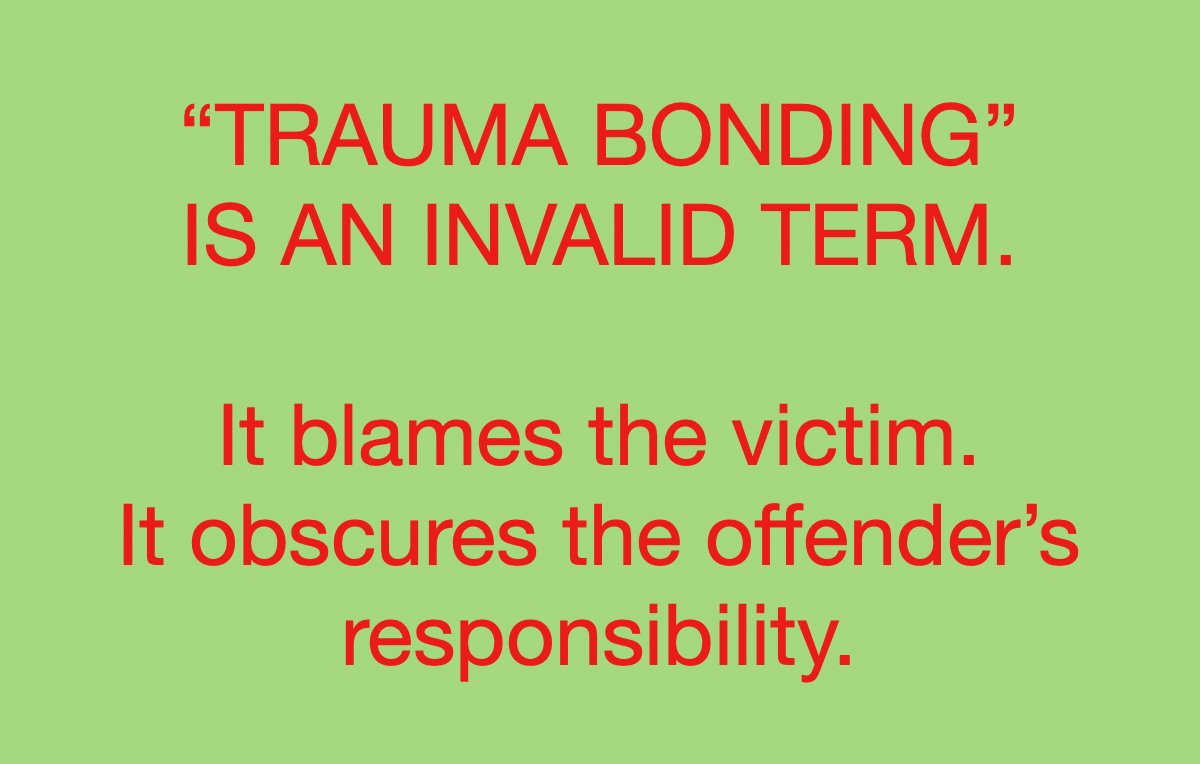 To be clear, I’m not referring to the bond that happens between two victims sharing their trauma together, for example, bonding after natural disasters, victims in support groups, etc. That definitely happens and is a good thing. I’ve met the best of friends through the journey of healing trauma from abuse. I’m officially referring to the term “Trauma Bond”.
This post was primarily written by Kate Palmer Bowers, so “I” means Kate.
Barbara Roberts has adapted Kate’s original post to fit the formatting of this blog, and added some material and links.
The term “Trauma Bonding” was coined by misogynist Dr Patrick Carnes, who created most of the sex addiction industry1, and who stated in his sex addiction book that parents are naturally sexually attracted to their own CHILDREN 🤮 …he’s not the most reliable dude.
Here is a Kindle screenshot of Patrick Carnes saying parents are naturally sexually attracted to children, and also where he talks about a father named Vern who raped his daughters. But Carnes didn’t call Vern’s behaviour rape, sexualised violence, abuse, molestation, or any of the more accurate terms. He called it “intense sexual activity” — implying it was mutual and consensual. Carnes never once called Vern an abuser or said his behaviour was abusive. But Carnes made sure to talk about “poor” Vern’s childhood trauma, and had no issues calling his childhood trauma “abuse”.

FACT: It is legally impossible for a person 15 years or younger to consent to sex. In some countries there are minor exceptions to that based on age, but broadly speaking it’s the same around the world.
According to Carnes, “Trauma Bonding” essentially means that:
- Victims don’t leave abusive relationships because victims are compulsively SEEKING to be abused (meaning they compulsively want to be abused).
- Victims are addicted to trauma.
- Victims are addicted to being abused, and are also abusers themselves.
- Victims are just as messed up as the abuser.
- Victims are “Codependent”.
- Victims end up being abused because they are just acting out past childhood traumas.
These are all myths and false narratives. There’s zero evidence of any of it. There’s no evidence that victims get addicted to trauma, abuse, OR abusers.
Patrick Carnes was influenced by the writings of people who loved Dutton and Painter.
Dutton and Painter coined “traumatic bonding” which was similar to trauma bonding but different. Dutton and Painter never called it “trauma bonding”, Carnes was the first to do that. So most of the info online about trauma bonding came from Carnes’ teachings. Interestingly Dutton and Painter weren’t as victim-blaming as Carnes is either. Oddly Carnes never actually gives credit to Dutton and Painter though.
My guess is Carnes must have been inspired by others who were influenced by Dutton and Painter. But what’s interesting is that Dutton and Painter and many other professionals who believed victims can get “addicted” to trauma / abuse, were actually influenced by a dude named Bruno Bettelheim.
Bettelheim theorized that victims try to act like the perpetrators, and he helped fuel the myth that victims become “addicted” to abuse / abusers. So Bettelheim’s writings and teachings inspired a whole slew of victim-blaming myths.
Bettelheim turned out to be a complete fraud and liar! 🤯. He was never a psychologist like he said. He was just a Freud wanna-be who lied about his credentials, and ended up molesting HUNDREDS of women and children put into his care at both the college he was a director at, and the hospital he ran for autistic children.
And people to this day (like Bessel Van Der Kolk 🤮) STILL cite Bettelheim’s “scholarly” whackadoodle papers as “evidence” that victims become “addicted to abusers”, even though Bettelheim never once actually proved anything, it was just his misguided irrational thoughts. 🤦♀️
Overall, in both Carnes’ model and Dutton and Painters’ model, the label “trauma bonding” or “traumatic bonding” believes there is something inherently wrong with the victim, and THAT’S why they were abused. Not solely because of the perpetrator’s choice to abuse and injure the victim, but because the victim has underlying issues that “led” them to be abused and become “trauma bonded”. They believed part of the cause of the victim being victimized lies with the victim. The fact is, perpetrators abuse because they CHOOSE to abuse, and the responsibility solely relies on them.
Abuse is deliberate. We know this because perpetrators of abuse anticipate resistance from victims and take deliberate steps to conceal and suppress it. Even so-called “explosive” or “out of control” acts of violence involve choice and controlled, deliberate action. (More on that HERE.)
Based on official definitions of “victim blaming” by the U.S. Dept of Justice, United Nations, Harvard law, anything that puts responsibility onto the victim for why they were victimized is defined as “victim-blaming”. (Kate Palmer Bowers has definitions if you want to read those as well.) Therefore “Trauma Bonding” is most definitely considered victim-blaming.
Despite there being no real evidence, “Trauma Bonding” spread like wildfire, just like all the other victim-blaming labels. Some other victim-blaming labels are Codependency, Reactive Abuse, Drama Triangle (Karpman Triangle), Stockholm Syndrome, Learned Helplessness, Prodependency, Repetition Compulsion, Self-Love Deficit Disorder, Human Magnet Syndrome, and implying victims are at fault for Ignoring Red Flags.
The term “Trauma Bonding” was taken up and promoted by Patrick Carnes’ daughter, Stefanie Carnes, who has taken over her father’s empire. (More on that here: Why The Carnes/CSAT Empire Is Victim Blaming.)
The label “trauma bond” has become extremely popular. Yet most people and professionals either don’t have a clue about the patriarchal / misogynistic victim-blaming foundation it was created in, or, they fully agree with it.
Here are a few quotes that further show why it’s victim blaming:
partners will be tempted to stay in exploitive relationships that are unhealthy because they are addicted to the trauma. We use terms like love addict or relationship addiction or traumatic bonding to describe situations in which a person cannot let go of a partner who is destructive to oneself or others.
Noted neuroscientist Louis Cozolino suggests that codependence is rooted in “stress addiction” because of trauma. When noted researchers speak of addiction to the trauma, the world is full of examples. Just think of ones you know: … spouses who stay in battering situations … sexual abuse victims who work as prostitutes.
— Mending A Shattered Heart, Stefanie Carnes
Common Dynamics in Addicted Relationships: Trauma Bonding:
…Partner believes or tolerates addict’s lies and manipulations … Partner stays in a relationship that s/he knows is abusive … Partner tolerates exploitation … Partner may be repeating patterns from past relationships.
— Facing Heartbreak: Steps to Recovery for Partners of Sex Addicts, Stefanie Carnes, Mari A Lee, Anthony D Rodriguez
It is very important for codependents to understand the elements of trauma bonding. It is also critical for persons struggling with a traumatic bond to understand the nature of codependency. There is a rich set of resources and an extensive set of support groups that can help sort through denial and help manage reactive responses. Many survivors who have trouble with trauma bonding are addicts themselves. They can also participate in groups appropriate to the addictions they have. …
Each of these conditions adds to the emotional bond and deepens addictive attachment … repetitive cycles of abuse … confusion about love … there is a history of abuse … there is a familiar role and script to be fulfilled … victims and victimizers switch roles of rescuer and abuser …
Compulsive Abuse Seeking — The victim sets up relationships to repeat the same patterns of abuse. This creates familiar binds, neuro-chemistry, and coping strategies. For a relationship to work, it must comply with the original abuse scenario. What can vary is the amount of risk and intensity. Adults may combine a number of abuse scenarios to get the desired effect. At the core of every addiction is compulsive behavior. Compulsion means that you exhibit the behavior even though you know it is self-destructive. You cannot stop it on your own. Traumatic bonding is essentially a compulsive relationship with very definite patterns of compulsive behavior.
— The Betrayal Bond, Patrick Carnes
Trauma Bonds — What we see is highly addictive attachment to the persons who have hurt the clients… These attachments cause the clients to distrust their own judgment, to distort their own realities so much, the clients can place themselves at more risk. The clients are bracing themselves against further hurt. Taking precautions which almost guarantee more pain. These attachments have a name. They are called trauma bonds. … These occur when a victim bonds with someone who is destructive to them. Similarly, adult survivors of abusive and dysfunctional families struggle with bonds that are rooted in their own trauma experiences. To be loyal to that which does not work — or worse, to a person who is toxic, exploitive, or destructive to the client, is a form of insanity.
— CSAT course by Patrick Carnes, https://healingtreenonprofit.org/wp-content/uploads/2016/01/Trauma-Bonds-by-Patrick-Carnes-1.pdf
Let’s break down this nonsense
ABUSE VICTIMS ARE ADDICTED TO THEIR ABUSERS
No. The chemicals involved with addiction are different than the chemicals involved in bonding. As a recovering addict as well, I personally find it offensive to imply that a woman’s desire for love and connection is put in the same category as the perpetrator who is choosing to harm her. There’s this notion out there that seems to believe that if feeling romantic love for a partner activates only a few similar neurons in the brain as being addicted to a substance, then it must mean you’re addicted to the activity as well! 🥴 If this were true then everyone in the world would be addicted simply for needing human connection. Or for running, or swimming, or even giving birth (—>”Aw, you feel so happy and love your baby so much!? Congratulations, you’re addicted👍👏🎉… 🙄). While studies show love and addiction ARE similar in the beginning stages (just like most rewarding things in life..), they actually don’t activate all the exact same neurons in the brain, especially in the oxytocin system. There’s a difference!
IF ABUSED WOMEN AREN’T ADDICTED TO THEIR ABUSER, THEN WHY DO THEY STAY??
This is a myth. Statistically most abused women do eventually leave. But even if a victim stays, it’s not because something is wrong with her. She stays for various of reasons. Heck, sometimes staying is the safest option. Sometimes they stay because they can’t leave, etc. For example, imagine seeing a man walk up to his wife and cut off her legs, and she’s utterly confused, screaming and pleading with her husband and everyone around to help her. Would you ever say to that woman “Why don’t you run away? Why do you keep taking his crap? What insecurities or childhood trauma led you to getting your legs cut off? Why were you seeking to get your legs cut off? Geez lady, you must be addicted for sticking around!” ??? No! Because that would be a horrible thing to say.
This is what abusers do. Their choices to cause harm are debilitating for victims. It literally injures women and can metaphorically chop their legs off. And despite all that victims STILL find ways to actively resist abuse and better their situations. That’s AMAZING 💗 So why is everyone more focused on what’s “wrong with the victim”, instead of why the perpetrator keeps CHOOSING to abuse?
BUT SURELY SINCE SHE MARRIED THE ABUSER, SHE MUST HAVE ISSUES THAT ATTRACTED HER TO AN ABUSER, RIGHT?
Wrong. Think of it this way, if she married a healthy man, no one would think twice about her loving nature, her personality, or her “bond”. No one would call it unhealthy. No one would say she’s addicted, seeking abuse, or responding irrationally. Yet, if a man chooses to abuse her, people suddenly say she’s addicted to him. Why is that? Because men have blamed victims for thousands of years and have been convinced that if you’re a victim then there “must” be something wrong with you, in order to make themselves feel safe in their little homes and keep up with their “Just World” theory. (Google Just World theory. Very interesting.)
We can’t automatically pathologize a woman’s human nature or personality and call it unhealthy simply because she’s with an abusive man. He wasn’t always an abusive man. She’s solely in a relationship with someone who turned out to be an abuser because the abuser lied, and because misogyny still dominates the world, making the odds of finding a healthy man against all women. That’s it. It’s that simple. We aren’t human lie detectors, we can’t know when someone is lying 24/7. Abusers even fool therapists, friends, family, police, etc. Should we pathologise them as well and tell them there’s something wrong with them for believing the abuser? There’s nothing inherently wrong with a woman who is abused. She’s simply injured and exhausted. She didn’t “bond” to him because she’s addicted, unhealthy and has childhood trauma, etc. She bonded to him because she was bonding to someone she loved and was led to believe was a good guy. I guarantee she wasn’t like “Ope, he’s a jerk and is going to ruin my life, I’d better partner with him, that sounds fun! 👍” 😶. She was doing what humans are meant to do… and he chose to lie.
I’m not saying a victim isn’t experiencing anything chemical caused by the abuser. But I see it more like starvation. If an abuser tortures and starves a victim, especially with random intermittence, is it at all shocking that the victim becomes utterly obsessed with food, thinking about it all the time, depressed, tired, irritable, etc? No, that would be a completely normal response that the human body would naturally go through. It has nothing to do with how healthy a person is, being addicted, or their childhood experiences. It’s a built-in bodily response to not getting something our bodies need for survival. We wouldn’t blame the starving victim for being hungry, we would blame the abuser for starving her. So why is it any different for a victim who is being starved of other physical needs, like love, connection, and safety?
VICTIMS LACK BOUNDARIES AND SELF-ESTEEM, OR THEIR CHILDHOOD TRAUMA LED THEM TO BELIEVE ABUSE IS ACCEPTABLE, THAT’S WHY THEY ENDED UP BEING ABUSED.
If this were true then we wouldn’t see victims resisting abuse, yet ALL victims resist abuse (since no one wants to be abused). And that resistance is proof that victims do have enough self-esteem, boundaries, etc.
UNDERSTANDING RESISTANCE IN PRACTICE
Resistance can take many forms – from overtly standing up to a perpetrator, to small acts or thoughts that go unnoticed by others. These acts of resistance represent a victim’s efforts to resist, defy or strive against the abuse and their efforts to maintain their dignity.Often acts of violence and acts of resistance are hidden. Focusing on a victim’s responses to adverse situations is known as response-based practice. At its core, a response-based approach to practice is about noticing how, in any given moment, a person exercises some caution, creativity, deliberation, and awareness that enables them to handle a difficult situation. It is about interpreting these responses as forms of ‘resistance’ that victims use to keep hold of and reassert their dignity.
— Read the whole article here: Understanding Resistance in Practice (Internet Archive link here.)
As long as there’s victim blaming, studies show perpetrators aren’t held accountable. If we as a society want perpetrators to be held accountable and for victims to stop being harmed, then we MUST stop blaming victims, especially with our language and beliefs.
“Victim” is not a weak, shameful word
#traumabond #traumabonding #traumabondingisNOTreal #StopVictimBlaming
Update added by Barbara Roberts December 2025. If anyone is reluctant to stop using the term ‘trauma bonding’ because they think it connects well with attachment theory, please read this comment. [end of update]
- Patrick Carnes created the awful CSAT training which accredits “Certified Sex Addiction Therapists”. He also created IITAP (International Institute for Trauma and Addiction Professionals).
Note added by Reaching Out. Broken links: If any of the links in this post are broken, a new Internet Archive copy was made just after this post was published, and can be found in the Internet Archive. A link to the Internet Archive to help you get started can be found here. 😊
Post updated Dec 2025.
Discover more from A Cry For Justice
Subscribe to get the latest posts sent to your email.


This is so incredibly good.
LikeLike
memphisrayne,
You wrote (11th July 2025):
….to see you again, memphisrayne. 😊 😊 😊
(I’m planning on commenting on this post by Kate Palmer Bowers and Barb….hopefully sooner rather than later. I was so happy to see memphisrayne again I couldn’t wait to comment. 😊)
LikeLiked by 1 person
Adding on to my comment of 11th July 2025…
I wanted to write three things before I write anything else….
First. My apologies for taking so long to comment….as I’ve written a number of times over the last long while, I’ve been having to deal with a VERY lengthy process of healing some childhood stuff I call that “weirdness” about my mother.
Second. I wanted to say thank you to Kate Palmer Bowers and Barb for an excellent post. 😊
Third. I wasn’t quite sure how to write what I wanted to say without giving Patrick Carnes and his ilk any oxygen.
If the reader reads Kate Palmer Bowers and Barb’s entire post first, than reads the section of the post that contains all the quotes, starting with Stafanie Carnes first quote and ending with Patrick Carnes’ CSAT course quote, one thing stands out: They are attempting to gaslight everyone about “trauma bonding”.
I thought of writing about this in greater detail, but I didn’t want what I wrote to be mis-construed as an attack, and thus have my comment “written off” as some kind of personal attack.
LikeLiked by 1 person
I’m so thankful you brought up this life saving info. To me, this is right on par with the rich patriarchal soul destroying of women and children…
This is some personal info: I was asked by a monster who happened to be a Reunification therapist how I could stay so long with so much physical and sexual abuse. He claimed that dad and daughter needed to be reunited asap due to my extreme trauma bonding with dad.
To make matters worse, before trial my past therapist (who I had filed a report against) released to this Reunification therapist a montage of horrific sex addiction diagnosis and the ensuing five year treatment that increased our danger.
The Reunification therapist’s main question to determine if I was sex addict was this: “Have you ever had sex when you didn’t want to?” “Yes, all the time”, I answered, talking about rape.
He actually redefined it through Carnes work, then told me if it was a full blown sex addiction, it was a love addiction!! The pride! Injustice! The degradation!
LikeLike
(I’m posting this for Sister but plan to add my own comment later.)
Kate and Barbara!
I really appreciated this post about terminology, “trauma bonding”, Carnes, Bettelheim, the examples and analogies, ….! It is right on target 100%! (Ties in with Allan Wade’s (Canada) significant work on the use and abuse of terms.)
Thank you!
P.S. So glad to see Memphis Rayne back!
LikeLike
For folks who are reluctant to stop using the term “trauma bonding” because they think it connects well with attachment theory.
Attachment theory has major limitations when applied to victims of intimate partner abuse.
An advocate I respect who is doing a Masters in Criminology with focus on IPV (intimate partner violence) has shared some very helpful info in a private group and I am pasting her comment here anonymously to protect her safety.
LikeLike
Excellent article, especially the nuanced approach to describing how intermittent reinforcement causes cravings for affection somewhat similar to the way a starving person craves food.
In my experience, the reason why I sought affection from my abusive husband was because he wore down my self-esteem to the point where I believed he was the only person who would ever be willing to put up with me. I was deeply grateful for the tiny shreds of affection I occasionally received because I believed that nobody else would ever “love” me even that much. Once I learned what consistent love and care actually looked like (from our cat – he’d successfully isolated me from all close human relationships), all of my pathetic gratitude and adoration melted like snow in the sunshine.
P.S. I hope you’ll forgive some unsolicited feedback (and feel free to redact this bit), but I hope you might be willing to reconsider your inclusion of “the wandering womb” and “hysteria” under junk science in future posts. The wandering womb was actually an early description of endometriosis — bits of womb were found to have “wandered” from their normal location [as was discovered] during the autopsies of dead endometriosis sufferers that were performed by their confused doctors. Doctors now refer to this as endometrial tissue, same stuff. The hysteria that was often associated with it was the women screaming, sobbing, moaning, vomiting, and begging for pain relief or unconsciousness during their periods (hence “hyster” in the name, like in hysterectomy etc).
As someone who’s experienced both, I feel confident in saying that endometriosis patients are to the medical system as domestic abuse victims are to the legal system, so I’m sure you’ll understand why I’d prefer the medical community don’t gain any more justification to brush us under the carpet. Anyway, I could rant on this topic all day, so I’ll let you escape now. Thanks!
[One paragraph break added to enhance readability. Editors.]
LikeLike
Thanks for the feedback about endometriosis being linked to the junk science concept of “wandering womb”, and the excruciating pain of endometriosis being attributed to “female hysteria”. If you have online articles that verify this, feel free to submit another comment.
I Googled “wandering womb” and found articles saying the concept goes back to the Ancient Greek medical texts (Wandering womb [Internet Archive link here.]). I also found articles saying that the concept of female hysteria goes back to Ancient Egypt and Greece (Women And Hysteria In The History Of Mental Health [Internet Archive link here.]).
[I took the liberty of adding the Internet Archive links to Barb’s comment. Reaching Out.]
LikeLike