

The person who operates from The Colonial Code of Relationship1 is carrying out a mild, moderate or severe version of coercive control. I therefore urge all would-be-helpers to understand the Colonial Code of Relationship, in order to avoid doing it to victims.
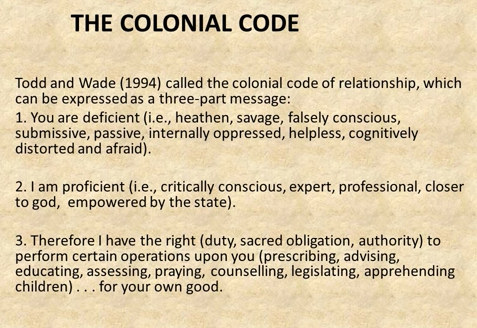 Here is my adapted version of the Colonial Code of Relationship. I’ve expanded some of the wording so it covers more things that are done in Christian contexts.
The Colonial Code of Relationship goes like this:
- You are deficient.
- I am proficient. (I am expert, professional, have more education and qualifications than you. I am empowered by the church, the State, the licensing board. I am closer to God. I am more trustworthy than you because I am male / white / married / have no unhealed trauma, etc.)
- Therefore I have the right (duty, sacred obligation, authority) to perform certain operations upon you. (Fix you, psychologically or spiritually diagnose you to prove you are deficient and inferior to me, constrain you, lock you up, counsel you, tell you how you should feel, prescribe what you should do even though my prescription disrespects your liberty of conscience, prescribe how you should or must think, pray over in a haughty manner, lay hands on you without your consent, lord it over you, legislate and punish you to restrain your Christian liberty of conscience, disregard your views because you are female or because you have suffered trauma in the past, impede your liberty to protect yourself and your children as best you see fit, etc.)
- These operations are undertaken for your own good.
Jesus told his followers not to operate from the Colonial Code of Relationship.
After he had washed their feet and received his clothes and was seated again, he said to them, Do you understand what I have done to you? You call me Teacher and Lord, and you say well, for so I am. If I then, your Lord and Teacher, have washed your feet, you also ought to wash one another’s feet. For I have given you an example, so that you will do as I have done to you. Truly truly I say to you, the servant is not greater than his master, nor the messenger greater than he who sent him. If you understand these things, happy are you if you do them. — John 13:12-17 (NMB)
Are there any times when it is right for a ‘helper-person’ to over-ride the victim’s agency?
There are a few situations where a qualified and licensed ‘helper-person’ is legally allowed to over-ride the agency of a victim of abuse.
Child Protection is legally empowered to step in to protect children from being abused. But in domestic abuse situations this can be a minefield, because Family Court systems and Child Protection systems are often failing to protect children from the abusive parent2 — and the protective parent (who is usually the mother) can do nothing about it because the System won’t let them. My heart goes out to all erased mothers!
When a person is at risk of harming themselves or harming others, the psychiatric system is legally empowered to put the person in psychiatric hospital until the risk of self-harm or harm-to-others is deemed to be reduced and it’s safe to release the person.
It is right for society to over-ride a person’s agency when the goal is to prevent a mentally disturbed person from harming themselves or others. However, it is wrong to diagnose a victim of abuse as “mentally ill” simply because the victim is resisting their perpetrator’s abusive tactics by setting boundaries against the perpetrator and taking steps to get herself and her children safe.
It is mentally healthy and righteous to set boundaries against perpetrators! Victims invariably resist violence and other forms of abuse.
Violence is permitted when used in self-defence, but the violence must be appropriately proportionate to resist and avert the threat. Disproportionate violence is not allowed in self-defence. Go here to read more on the biblical principle of self-defence.
A final reminder to all people-helpers who claim to follow Jesus.
In 1 Peter 5:3, the apostle warned elders, under-shepherds and would-be-helpers not to lord it over those entrusted to them.
Jesus had to sternly rebuke his disciples when they tried to operate from the Colonial Code of Relationship and jockeyed for positions of superiority.
James and John, the sons of Zebedee, came to him, saying, Teacher, we would like you to do for us whatever we ask. He said to them, What would you like me to do for you? They said to him, Grant to us that we may sit one on your right hand, and the other on your left hand, in your glory. But Jesus said to them, You know not what you ask. …to sit on my right hand and on my left hand is not mine to give, but is for them for whom it is prepared.
And when the ten heard this, they began to be much displeased with James and John. But Jesus called them to him and said to them, You know that those who are seen to bear rule among the Gentiles reign as lords over them. And those who are great among them exercise authority over them. It shall not be this way among you, but whoever would be great among you shall minister to you, and whoever would be chief shall be servant to all.
— Mark 10:35-44 (NMB)
- Sources for the Colonial Code of Relationship:
Domination, deficiency and psychotherapy, Nick Todd and Allan Wade (The Calgary Participator, 1994, Fall). (Internet Archive link here.)
Webinar: Response-Based Practice with Aboriginal Children & Youth
“Resistance knowledges: therapy with aboriginal persons who have experienced violence”, article by Allan Wade in A PERSISTENT SPIRIT. Towards Understanding Aboriginal Health in British Columbia, Canadian Western Geographical Series, 31. Victoria, BC: Western Geographical Press, 1995. (Internet Archive link here.)
Islands of Safety and the Social Geography of Human Dignity: A Child and Mother Safety Planning Initiative for Cases of Paternal Violence in Child Welfare, by Cathy Richardson.
***
Further reading and viewing
Respecting & Listening to Victims of Abuse
Language and Violence Masterclass by Dr Linda Coates
2 Family Courts: Highlighting the Voices of Abused Mothers [Internet Archive link] — by Dr. Emma Katz, July 21, 2024 (link added in case the original gets broken).
Discover more from A Cry For Justice
Subscribe to get the latest posts sent to your email.


Barb,
I love your post! 😊 You’ve put into words something I’ve been saying for YEARS!
You wrote (in your post):
THIS is what I was born into and grew up with — a nominally Christian (and very abusive) family that dropped the church-going part of Christianity when I was a very young child. Yet all the rules remained.
If anyone has followed my breadcrumbs that I’ve strewn throughout the ACFJ blog (they really only make sense if you read them in order, from the earliest to the latest 😊), you might — or might not — be able to see the pattern.
Much as I would love to go to church, I’m no longer able to do so. 😢 (Omitting details for my safety and protection.) And even online “church-going” doesn’t work. 😢 (Once again, omitting details for my safety and protection.)
But then, how many other Christian abuse victims and / or Christian abuse survivors say the same thing?
That doesn’t change the fact that we’re still Christian, although so many people say otherwise….
LikeLiked by 1 person
Finding Answers, I’m so sorry for what you family did to you! They were truly horrendous abusers.
I don’t go any church any more. Well, that’s not quite true, I went once in early January when I was visiting Melbourne, but I kept myself in my own little bubble during the service and the coffee time afterwards. The best part of it was how I empathised with a toddler at the back of the church. I was sitting right at the back, where there was a kids / parents area with toys for the kids.
I wouldn’t even try online church as I know it would trigger me just as much as live church services do.
My Bible reading this morning led me to Zephania 3:18-19 —
LikeLike
Barb,
You wrote (15th March 2025):
One of the things I found hardest about going to church is being able to, as you wrote, keep myself in my own little bubble. Children are so often able to stay in their own little bubble, playing games, etc….until adults “train that out of them”. I get so tired of the idea that a person in church MUST be friendly, MUST smile (or be solemn, or whatever), MUST be willing to talk (or be silent), MUST be willing to introduce themselves, etc.
Sometimes, some of my greatest joys in going to church were when I went to an empty church and just sat there. I’d look around….at the organ if they had one, at the stained glass windows if they had any, at the cross — if it was an empty one, and not the crucifix….I’d just sit there with my own thoughts, admiring the beauty.
LikeLiked by 1 person
Barb,
This was a truly satiating and empowering post! I absolutely love how you broke down the Colonial Code of Relationships in a way the reader could grasp it. Everything you shared is so poignant and serves very important reminders about how we should be interacting with survivors. I’m particularly appreciative that you spoke out about Family Court and victim mothers. Thank you!
LikeLike
Thank you, Marielle (The Kindred System). :) :) :)
LikeLike