

Exodus 21:7-11 spells out some of the obligations of a male head of household in Ancient Israel. If he had a young indentured maidservant in his household, and he married her to his son, he must provide her with food, clothing, and ʿônâ, even if the son took a second wife.
If the male head of household stints her of food, clothing, or ʿônâ, she is free to leave without penalty: the master (and his son) must not exact retribution on her or her family of origin. (I’ll go into meaning of ʿônâ soon, so be patient.)
English Bibles use the word “master” for the male head of household, so that’s the word I’ll use for him in this article.
A law which gives rights to a young female servant who has been married to the master’s son must give similar rights to any wife.1
So the same principle applies to a married woman today: Exodus 21:7-11 allows a wife to divorce her husband should he fail to provide food, clothing and ʿônâ. If her husband does not provide those three things, she is allowed to divorce him and he must not exact retribution.
This leads to an obvious conclusion:
Exodus 21 allows a wife to divorce a hard-hearted husband.
 What does the phrase “her food, her clothing, and her ʿônâ” mean?
It seems to be an idiomatic phrase translated in our terms as her ‘full board and lodging’ or her ‘full subsistence.’
— Rt Revd Prof David C Nicholls, GCLJ, MA, PhD, SLittD, Professor of Hebrew Bible, quoted on page 4 this article. For more info on David Nicholls go here. To see the phrase in Hebrew, go here.)
Food and clothing
Food and clothing are pretty easy to understand so long as we know a bit about the culture of the Ancient Near East. In the traditional division of labour, men did the heavy work in the fields and herding animals, so the husband / male head of household was obliged to provide the raw agricultural products (grain, fruits, meat, oil, wool, flax, etc.) from which women cooked the food and made clothing. Learn more here: Cultures of the Bible were Patricentric and Heterarchical, @WeWhoThirstPodcast.
While Exodus 21:10-11 specifies the man’s obligations, the Jews understood these obligations as applying to both husbands and wives in their different spheres, which were largely determined by the reality of agrarian life where a household was not just a domicile, but the workplace where raw materials were processed into goods.
The word ʿônâ (Click here to hear it pronounced.)
This word occurs only once in the Bible, so Hebrew experts have little evidence to go on to establish its meaning. Strong’s Dictionary says that it comes from an unused root apparently meaning “to dwell together”. STEP Bible defines it as “cohabitation” (see here). The English translation of the Septuagint rendered it “companionship” (see here). I asked Professor Nicholls and he said, “it seems to refer to co-habitation with conjugal rights. Yes, there is a sexual dimension to it but only a part.”
Ruth Magnusson Davis explains Tyndale’s understanding of Exodus 21:7-11 in her academic paper on Exodus 21 (Exodus 21 Concerning Daughters Sold into Service: Virgins, Concubines, or Slave-wives?) and her shorter article (Daughters Sold into Service: Exodus 21, William Tyndale’s Translation).
To help us understand, I am going to convey in bullet points the main points of Ruth’s two papers. Non-bulleted things are my own.
- The general context in Exodus 21 is the treatment of indentured bond-servants in Israel under Mosaic law.
- An indenture is an agreement by which a person binds himself to serve another, but may also refer to an agreement binding a person’s child to service.
- Verses 1-6 deal with menservants who enter into service either married or single.
For a manservant, the term of indentured service was six years, and in the seventh year “he shall go out free, paying nothing.” (Exodus 21:2)
- Verses 7-11 deal with the situation of young girls, virgins, sold into service by their fathers.
Here is Tyndale’s translation of Exodus 21:7-11. I’m quoting it mostly from the NMB Pentateuch. Italicised words in parentheses are straight from Tyndale’s translation, and I’ve shown where the word ʿônâ occurs in verse 10.
7 If a man sells his daughter to be a servant: she shall not go out as the menservants do.
8 If she does not please her master, so that he gave her to no man as wife (he hath given her to no man to wife), then shall he let her go out free. To sell her unto a strange nation shall he have no power, because he judged her unworthy (he despised her).
9 If he has promised her to his son as wife, he shall deal with her as men do with their daughters.
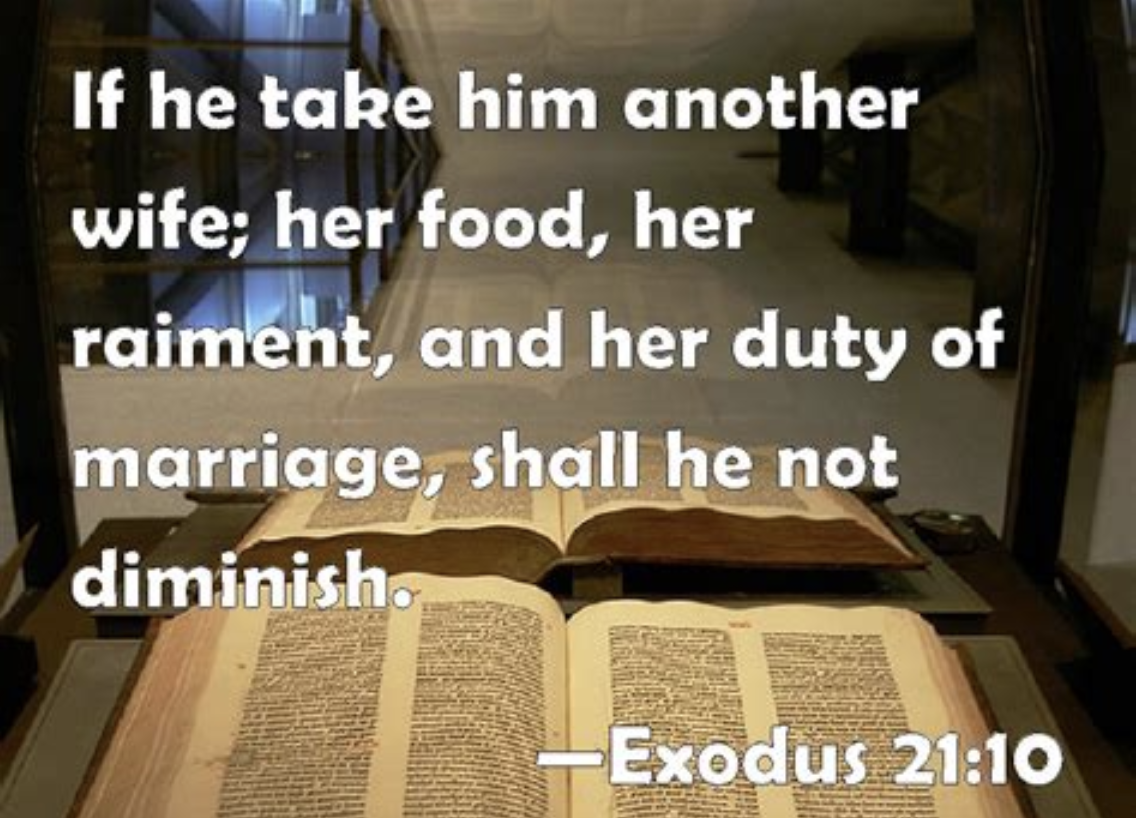
10 If he takes another wife for his son, still her food, raiment, and lodging (ʿônâ) he must not diminish. (If he take him another wife, yet her food, raiment, and duty of marriage (ʿônâ) shall he not minish.)
11 If he do not provide these three things for her (If he do not these three things unto her), then she shall go out free and pay no money.
- We learn from this passage that aside from financial considerations, ancient fathers had good reason to sell their young daughters into service: it was a way to find a husband for their daughters.
Marriages were arranged between families, with the male heads of each household making the formal agreement, which usually involved an exchange of wealth between the two families. When an impoverished father couldn’t give his daughter a dowry, he could arrange with a wealthy householder to take her into service. In this passage, God set constraints to prevent the girl being exploited.
Deuteronomy 15:12-17 talks about both women and men entering into bond-service for a fixed term of six years and, if they choose to leave after serving their term, the master must supply them liberally from his flock, threshing floor and winepress. But Exodus 21 doesn’t specify a fixed term for a maidservant, perhaps because the passage focuses on the ‘duty of marriage’ obligation and constraining the master so he didn’t exploit the girl.
The maidservant would have lived in the master’s household, which was probably comprised of multiple generations of the family and multiple servants. All members of the household might not have lived under the one roof — there may have been a few large and several small buildings, or tents. (Think of Abraham’s household when his herds increased and he had many servants.)
- During a girl’s term of service, the master’s relation to the maiden was in loco parentis.
Part of the master’s duty of care, in loco parentis, was to arrange an appropriate marriage for the maiden, so that she would have the opportunity of enjoying marital intimacy and bearing children.
Verse 8
Verse 8 focuses on what should happen if the master did NOT find her a husband.
- The master’s obligation was to advance the maidservant’s interests, especially her opportunity for marriage, but if he could not or would not do this, the indenture agreement must be treated as at an end.
If she does not please her master, so that he gave her to no man as wife (he hath given her to no man to wife), then shall he let her go out free. To sell her unto a strange nation shall he have no power, because he judged her unworthy (he despised her).
- Tyndale probably used ‘despised’ in the obsolete sense ‘treated with contempt in word or deed’, meaning that the master had spoken or acted against the girl.
The Hebrew word which Tyndale rendered “despise” is bagad. Robert Alter translates it as ‘he broke faith’ with her, adding that the literal meaning of bagad is “betrayed”.
Bagad also occurs in Malachi 2:10, 15:
Why do we deal treacherously with one another by profaning the covenant of the fathers? … take heed to your spirit, and let none deal treacherously with the wife of his youth. (NKJV)
If the master didn’t appoint a suitable husband for the girl, the master was expressly forbidden to sell her to a foreign people, and he was obliged to let her ‘go out free’. ‘Go out free’ might indicate manumission — some kind of formal or informal process that rescinded the indenture agreement. The phrase ‘go out free’ slightly contrasts with verse 2 where the manservant, at the end of his term of service, was to ‘go out free, paying nothing’. Verse 8 gives no indication that if she ‘went out free,’ the maiden’s father would have to pay back the amount he’d received from the master when the indenture agreement was made.
The verb ya’ad in verses 8 and 9
8a If she does not please her master, so that he gave (ya’ad) her to no man as wife, then shall he let her go out free. …
9 If he has promised (ya’ad) her to his son as wife, he shall deal with her as men do with their daughters.
The Hebrew verb יעד (ya’ad) means “to fix upon (by agreement or appointment), to designate”.
Tyndale translated ya’ad as ‘gave her’ and ‘promised her’. But many English versions have translated it as ‘betrothed’, despite the fact that nowhere else in the Old Testament does ‘ya’ad mean ‘betroth’. (The Hebrew word for “betrothed” is ארשׂ ‘arash.)
‘Ya’ad’ means to appoint, or make an appointment. It is most often used of a meeting time or place called ahead of time. I rarely side with the ESV, but their word ‘designated’ isn’t too bad. But I don’t think that it would have been as binding as an engagement — perhaps because they were too young(?). I believe it would refer to a custom that we know little about — perhaps not quite an engagement, but a plan, or appointment.
— Ps Sam Powell, quoted on p 3 of Exodus 21 Concerning Daughters Sold into Service: Virgins, Concubines, or Slave-wives?
In verse 9, ya’ad shows the master deciding that eventually the maiden would be married to his son. So, while it’s not entirely illegitimate to translate ya’ad as ‘betrothed’ in this passage, translators who have rendered it as ‘betrothed’ have perhaps done so because they’ve been following the rabbis’ marginal note in the Masoretic Text, rather than following the Hebrew text itself. This gets technical, but I’ll try to make it simple.
The Masoretic Hebrew text of verse 8 has lo΄ (which means ‘not’) — whom he has NOT ya’ad. Tyndale rendered it “he gave her to NO man as wife”.
But in the Masoretic Text, the rabbis put a note in the margin saying that lo΄ should be read as low, which means “to him”. Translators who follow the marginal note say that the master ya’ad the woman TO HIMSELF, i.e., she became the wife or secondary wife (or concubine) of the master.3
Oodles of English translations say that when a father arranged for his young daughter to be an indentured servant in the household of a wealthy master, the master could or would betroth / espouse / marry her TO HIMSELF.
This idea originally came from Jewish rabbis. But the plot thickens!
William Tyndale was translating the Bible in the early 1500s and was hunted down, imprisoned and killed because he was translating the Bible into English.
Decades after William Tyndale was murdered, John Calvin’s followers produced their own English translation (the Geneva Bible), and in doing so they poured scorn on Tyndale’s translation. Ruth Magnusson Davis has done a deep dive into the differences between Tyndale’s and Geneva’s rendering of Exodus 21.
Geneva introduced significant revisions to verses 7-11, and also added shocking notes. Since then, the translation and interpretation of Exodus 7-11 has developed so that these verses are often understood to contemplate, not innocent provision for young maidservants, but situations where virgin daughters have been sold to be concubines or “slave-wives”.
— Exodus 21 Concerning Daughters Sold into Service: Virgins, Concubines, or Slave-wives?
The Calvinists in Geneva didn’t translate the Hebrew text of verse 8. Instead they translated from the marginal note in the Masoretic Text and rendered verse 8 as “If she please not her master, who hath betrothed her to himself...”
For some readers, the suggestion that the wealthy master (who was presumably much older than the maiden) would take the young girl to his bed is unpleasant. (Especially to those who have been molested, raped, or coerced into fornication or marriage by powerful men!)
The vast majority4 of English versions have followed suit with the Geneva Bible’s translation of verse 8, indicating that the master betrothed the girl to himself. Although they translate ya’ad in a variety of ways (betrothed, espoused, designated, selected, chose, married, took, handpicked), they all convey the idea that the master appointed the maidservant as HIS bedmate: his wife / concubine / slave wife / secondary wife. (See examples at stepbible.org and biblegateway.com.)
This has led to most English versions translating ʿônâ as marital rights / conjugal relations / conjugal rights / sexual intimacy. Only a few (like Tyndale) have rendered it duty of marriage.
Because so many English Bibles say the master intended the girl as a bedmate FOR HIMSELF, the common assumption has been that ʿônâ means conjugal relations (coitus).
(Dare I suggest that many translators have an undue preoccupation with a certain part of their anatomy?)
The fatal flaw in the idea that the master betrothed the girl TO HIMSELF.
The opening words of verse 8 are “If she does not please her master”. This sounds like the maiden is to blame for not pleasing her master. But what if we conveyed it as “If the master decides that she is displeasing to him,” or, “If the master thinks she is bad”. That would fit with what we know about many powerful men. It would fittingly convey that it was his choice to form a negative opinion about the maiden.
I think it’s important to make the master the active agent in this phrase. Language can be used to conceal violence and oppression, obscure perpetrator’s responsibility, and blame and pathologise victims. I am applying the research of Linda Coates and Allan Wade (Response-Based Practice) who have done micro-analysis into how language can be used when we are talking about interpersonal violence and oppression.
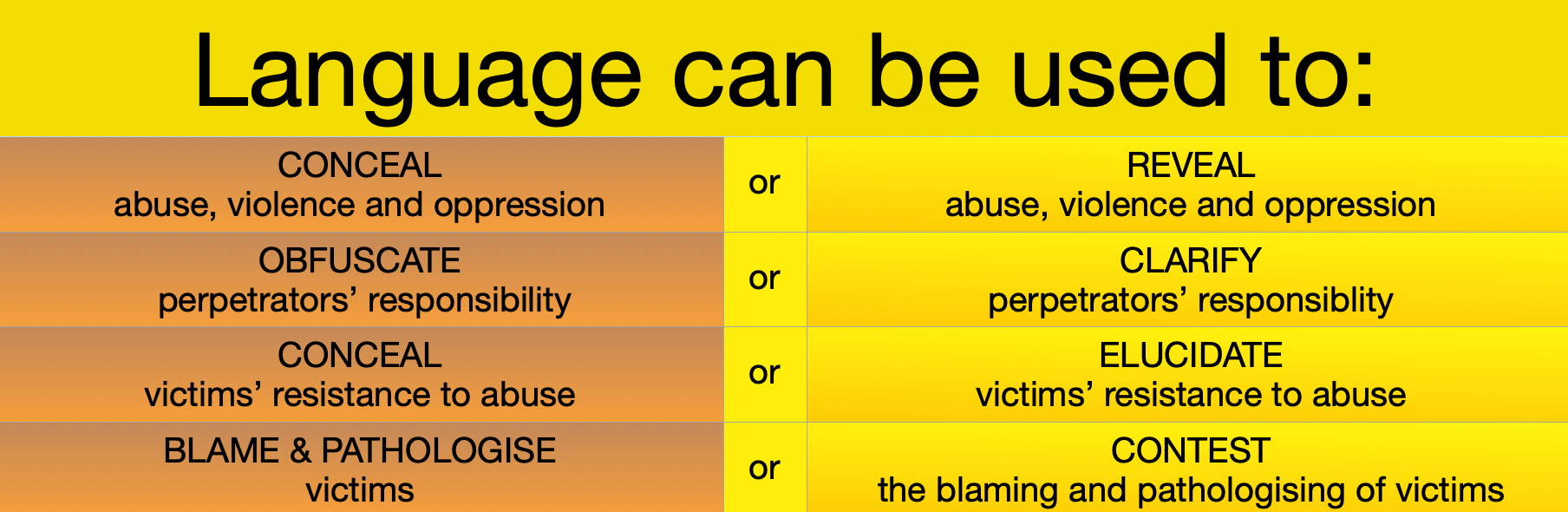
I think English translators of verse 8 may have been obscuring the master’s responsibility and concealing his abuse of the woman. Or, at the very least, they have been ambiguous or ambivalent about the master’s evil thinking, and all too eager to blame and pathologise the woman. I am not a Hebrew expert, but I know enough about Hebrew to understand that Hebrew grammar is very different from English. And I know that English translators have often misunderstood Hebrew idioms.5 I am suspicious that English versions have obscured the master’s active choice to think negatively about the maiden. If his negative opinion about her was subjective and self-serving, that would fit with him betraying her (bagad) at the end of the verse.
Verses 9-11
- Sometimes a Jewish master might promise the girl to his son as wife.
- If the master promised the girl to his son, he still stood in loco parentis to her. That is, he stood in the place of a father to her, as if she had been adopted into the family through marriage.
9 If he has promised her to his son as wife, he shall deal with her as men do with their daughters.
10 If he take another wife for his son, still her food, raiment, and lodging (duty of marriage – ʿônâ) he must not diminish.
11 If he do not these three things unto her, then shall she go out free and pay no money.
If she was promised to the master’s son, her status in the household was immediately elevated: she was to be treated as the master’s daughter-in-law.6
If she was promised to the master’s son, the master must not downgrade her status. (Side note: This has ethical resonance in Genesis 38. Judah had promised that he would marry Tamar to his third son when the son became old enough. By not keeping this promise, Judah betrayed Tamar, humiliated her, insulted her dignity, and downgraded her status in the community. In the end, Judah acknowledged that he had done wrong.)
Tyndale believed the master arranged another marriage for his son. But some English versions read verse 9 as the master arranging another marriage for himself. Other versions are less definitive, saying either If he takes another wife, or If he takes him another wife (with the ‘him’ being unspecified). (See Exodus 21:10 at stepbible.org and biblegateway.com.)
The lack of uniformity in translation shows how unclear translators have been about which man married a second wife. Was it the master’s son? Or was it the master himself?
I am not competent to arbitrate, but it’s a pretty important question!
If the master fulfilled his verse-9 promise by marrying the maidservant to his son, her ônâ must not be diminished even if the son married a second wife. If this is how we understand verse 10, and we read ‘he‘ as the son who must not diminish her ʿônâ, ʿônâ must include the son’s duty to not stint his first wife of sexual intimacy, but it would also include his obligation to provide her a proper home in which she had the opportunity to bear and raise children. And, in a multi-generational household, the master would still bear the overall responsibility of not diminishing his son’s wife’s provision of food and clothing. I think this reading makes the most sense, and is most consistent with the character of God.
Alternatively, we can read it like this: If the master promised the maidservant to his son yet did not fulfil that promise, but instead arranged a different marriage for his son, the ‘food, raiment and duty of marriage’ (ʿônâ) which the master owed to the girl still stood: he was obliged to continue giving her full board and lodging and arrange a suitable marriage for her. His duty was even more weighty, because, having promised her to his son, he must treat her as he would treat his own daughter.
Now let’s consider the reading that the master married the maiden, and then took another wife for himself. And let’s assume for a moment that ʿônâ refers only to sexual intimacy. As we’ve seen, verse 8 set out the possibility that master might form a negative opinion about the girl. If the rabbis and the vast majority of English versions are right and we should read verse 8 as the master designating the maiden to be married to himself, that creates a potential disjunct between verses 8 and 10. If the master married the girl, then formed a dislike of her and rejected her as a bed-mate, and then took a second wife who appealed to him more, why would he be required to make continual conjugal visits to his first wife (his former maidservant) in verse 10? This idea is out of accord with what we know about the character of God.7 God consistently reminds His people to protect vulnerable women! It makes no sense to think that Moses was saying that an Israelite woman was to be subjected to continual coitus from an Israelite man who had formed a decidedly negative opinion about her. What would he say and do to her in the bedchamber, under those conditions? Women who have been married to abusive men can easily imagine how soul-destroying this would be.
Now let’s consider the possibility that the master had initially planned to marry the maiden, but had formed a negative opinion about her and married her off to his son instead of himself. That sounds like a pretty crummy father! “Here son, she’s not very good, but you’ll have to put up with her, and you’ll have to keep providing her with marital intimacy even though I’m giving you another nicer woman!” What a sentence of desolation for the maiden!
Let it not be lost on us that Exodus 21 comes right on the heels of the announcement of the Ten Commandments in Exodus 20. The Fourth Commandment forbids the mistreatment of daughters and manservants and maidservants, and the Ten Commandments also forbid sexual immorality, covetousness (greed for what does not belong to you), and bearing false witness (Exodus 20:10-17). A wealthy master would bear false witness if he reneged on his responsibility to the maidservant and her father, by failing to promote her best interests and give her a proper home.
I will now recap my main point and connect it to the New Testament.
Exodus 21:7-11 allows a young female indentured servant to leave her master’s household without penalty if he failed to appoint a suitable husband for her and failed to provide her with food, clothing and ʿônâ. The passage also allows a wife to divorce her husband if he fails to provide her with food, clothing, and ʿônâ.
1 Corinthians 7:3-4 says that husbands and wives are to render due affection to each other, and that includes (but is not limited to) sexual intimacy:
3 Let the husband render to his wife the affection due her, and likewise also the wife to her husband. 4 The wife does not have authority over her own body, but the husband does. And likewise the husband does not have authority over his own body, but the wife does. (NKJV)
3 Let the man give due affection to his wife; likewise also the wife to the man. 4 The wife does not have right over her own body, but the husband, and likewise the husband does not have right over his own body, but the wife. (NMB)
Terms like “marital rights” and “conjugal rights” can sound like a strident call for ‘RIGHTS’ — a different flavour from rendering due affection.
Paul says that ‘due affection’ includes what happens in the bedroom. Let us apply that to Exodus 21:10.
If the girl becomes the master’s son’s wife, her ʿônâ must not be diminished. Even if her husband were to take a second wife, he would have to render due affection in the bedchamber to each wife in turn (as Jacob ought to have done with Leah and Rachel).
From this, we can infer that ʿônâ would include a proper home and sexual intimacy within the proper bounds of marriage. But we cannot say for sure that ʿônâ means only sexual intimacy.
As I said earlier, it makes no sense to think that Moses was saying that an Israelite woman was to be subjected to continual coitus from an Israelite husband who had formed a decidedly negative opinion about her. Indisputably, such a husband did not think well of the woman! The woman was free to leave him without any penalty or retribution (Exodus 21:11).
This idea is paralleled in 1 Corinthians 7:12-15. A believing spouse is to remain married if their unbelieving spouse is willing to live with them, but if the unbeliever does not think well of the believing spouse, the believing spouse is free to divorce. ‘Willing to live with’ is syneudokeo which means “be agreeable with, join in approval with, sympathise with, applaud, be pleased together with.”8
These days, the obligation of the husband to provide a proper home takes on a different character. Many women do paid work outside the home. High rents and mortgages often require both spouses to have paying jobs. Many couples have sensibly figured out that childcare and housework are best shared, rather than being divided along the traditional lines of agrarian pre-industrial cultures. Most modern homes are domiciles, not workplaces where agricultural goods are produced and processed to provide all or most of the food and clothing for the people in that household.
But the principle of providing food, clothing and a proper home still remains — and it’s easy to see when it is being violated by abusive husbands who shirk work, hide money from their wives, make their wives run the household on a cruelly tight budget, devour their wives’ inheritance, leave all the routine childcare and housework to their wives, shape their sexual arousal by porn, and use devious strategies to evade paying child support.
Ezekiel referenced Exodus 21
The precepts of Exodus 21 were picked up in Ezekiel where God rebuked His wife (the nation of Israel) for misusing the food, clothing, and lovingkindness He had given her. See here: The unfaithful wife in Ezekiel 16 — applications and misapplications
Deuteronomy 21 is another Mosaic Law that rules against husbands who abuse their wives
Deuteronomy 21:10-14 is harmonious with Exodus 21. It’s about marriage and divorce, and it gives dignity and rights to all wives regardless of their rank or status. It says husbands must not mistreat, humiliate, or brutalise their wives. It rules that if a man divorces his wife he must not make merchandise of her, sell her for money, or demote her to the status of a slave. It gives the divorced wife liberty to go wherever she wishes. Read more here: Deuteronomy 21 gives dignity and rights to the woman in both marriage and divorce.
Endnotes
- David Instone-Brewer says that in Jesus’ day all rabbinic schools construed Exodus 21:10-11 as a law permitting divorce on the grounds of neglect. Divorce and Remarriage in the Bible: The Social and Literary Context [Affiliate link], 99-110.
-
While Exodus 21:7-11 specifically holds the male head of household accountable if he fails in this duty, reproduction was actually considered a joint responsibility of both sexes. The female head of household had a lot of input in arranging marriages, see Jessica LM Jenkins wewhothirst.com, Naomi and Ruth: Stumbling Through Grief (August 12, 2025, Episode25), and her video Cultures of the Bible were Patricentric and Heterarchical.
-
According to Hebrew professor Sam Powell (See p 7 of Exodus 21 Concerning Daughters Sold into Service: Virgins, Concubines, or Slave-wives?):
In the Hebrew [Masoretic] Text, there are certain places where the ancient scribes, for whatever reason, thought that there should be some changes in the text. But they had such a respect for God’s word, they wouldn’t dare change the text itself. So they made their “edits” in the margin, as notes to the reader. These became known as the qere (to read) as opposed to kethib (as written). The kethib was the exact consonants as they were written. The qere were the marginal notes on how to read it. I believe that the kethib is inspired, and the qere you take with a grain of salt, as it were.
In Exodus 21:8, the kethib is lo΄, which means ‘not’. And that clause would be “whom he has not betrothed” — pretty much the way Tyndale has it. But the qere reading (in the margin) is low, pronounced the same, but with different consonants. It means ‘to him’, rather than ‘not’, so the translation would be “which he betrothed her to him” … So it depends on one consonant: lo΄ or low. The Hebrew gives us “which he did not betroth her”; the other [the marginal note] gives us “which he betrothed her to himself”. If you take the consonants as written, Tyndale was right. -
The only modern versions I’ve found that don’t indicate the master designating the maidservant as a wife for himself are the YLT, LSV, Smith’s Literal Translation, TLB, and perhaps the LEB. The only ancient or early-modern-English exceptions I’ve found are the ABEn, the ABP (interlinear LXX-English), and the 1568 Bishop’s Bible.
-
For more on Hebrew idioms, see Ruth Magnusson Davis’s paper Hebraisms in Genesis: Comparing the 1537 Matthew and 1599 Geneva Bibles. An English rendering that somewhat clarifies the master’s responsibility, and somewhat contests the blaming of the woman, is Carmen Joy Imes’ translation “If she is troublesome in the eyes of her master.”
-
1 Corinthians 7:36-38 talks about ‘a man’ and ‘his virgin’. Does this inter-textually echo Exodus 21:9-11?
7. Robert Alter [Affiliate link], following the rabbinic marginal note rather than the actual Hebrew, translated verse 8 as: “If she seems bad in the eyes of her master, for whom she was intended, he shall let her be redeemed…” But in his commentary on verse 10, he notes the disjuncture that comes from this translation: “Since the master has rejected her as a bedmate, it does seem odd to require him to make conjugal visits.”
- I discuss the significance of syneudokeo in 1 Corinthians 7 in my book Not Under Bondage: Biblical Divorce for Abuse, Adultery and Desertion, 40-41.
Post updated late Oct 2025.
Discover more from A Cry For Justice
Subscribe to get the latest posts sent to your email.


Brilliant, I think this is your best work yet. So glad it’s not just about sex-ona. And you’re right, male translators seem to have a preference for a certain body part and view point.
LikeLiked by 1 person
Thank you, Catherine!
LikeLike
Catherine Curtis and Barb,
My apologies, Barb, for taking so long to comment….I’ve read your post more than once 😊 ….and my apologies for having to comment this way (omitting details for my safety and protection)….I was planning on commenting without having to “piggy-back” off anyone’s comment. And thank you, Catherine Curtis, for writing a comment I can hijack part of. 😊
Catherine Curtis, you wrote (26th August 2025):
….or as some people say, a focus on pelvic issues. 😊
Your post is excellent, Barb. 😊 ….it’s hard to find something specific to highlight. 😊
One thing I did want to highlight from your post:
(The italics were done by me.)
LikeLike
Very in-depth and comprehensive. Thank you, Barbara!
LikeLike