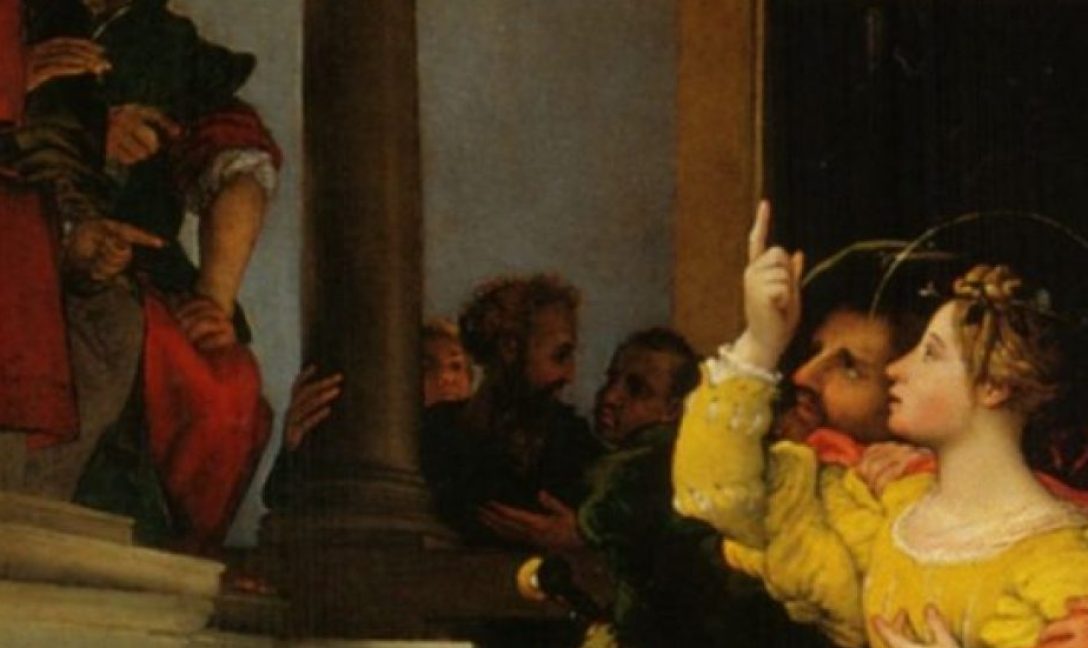

Medusa was actually quite a beautiful woman before she was sexually assaulted by a male god. The sexual assault transformed her into a grotesque monster-like creature who had to live in total isolation.
People only visited her to try to kill her, as some sort of quest or act of heroism. They were afraid of looking at her lest they turn to stone. She was dangerous, to be sure, but she was not born that way. She became that way.
This guest post by Helovesme first appeared as a comment on Barb’s Poetic Critique of Josh Butler’s “Beautiful Union”.
I took Greek Mythology in college (a long time ago; hopefully my memory is accurate). There are many stories of male gods having sexual relations with human women; described in words as “rape,” but in illustrations, however — it was portrayed as the women being “carried off”. It was not graphic, nor (visually) seemingly traumatic.
I do not recall this being explained or expressed as consensual, but it seemed moot to even have the discussion. The enormous power imbalance (god versus human) made escape impossible for the women. It seemed “understood” that the women had no choice; it was something that just “happened” in the world they lived in.
Sometimes the women would end up bearing children that were half god / half human, but on the whole, they seemed to just go back to their lives. I now wonder why so much storytelling acknowledges the existence of trauma, but omits emotional trauma. How do you endure something that is anything but normal, and then try to go back and live a normal life?
However, Medusa is an exception. She was actually quite a beautiful woman before she was sexually assaulted by a male god. It is how she became what she became: a grotesque monster-like creature that had to live in total isolation. If you looked directly at her, you turned to stone. And she had no way to choose to harm or NOT harm others. Her life is a story of something done to her that was against her will, and she ended up doing something to others against her will.
 If anyone tried to visit her, it was not to hear her story of how she got that way, and what it was like to live that way. Or, what her life was like before her transformation. It was to try to kill her, as some sort of quest or act of heroism. She was dangerous, to be sure, but she was not born that way. She became that way.
In America, on a day called Halloween, kids especially try to dress up as the scariest thing they can think of. It might be obvious to choose a “Medusa” costume, with the hair made out of snakes and whatever gruesome makeup to add to the cosplay [Internet Archive link].
But what about Medusa BEFORE she was assaulted? That male god was drawn to her beauty, but only sought to destroy it. And by the way, it had nothing to do with her actual looks. Whether she had dark hair or dark eyes, blonde hair or blue eyes is completely immaterial. Point is, would you want to dress up as what you imagined Medusa looked like at first, because the idea of being targeted by hate, is just as scary as what that hate transforms you into.
Also, think of victims post-abuse / assault. While our bodies may be traumatized, it may or may not show on the outside. We may or may not look pretty much the same, but on the inside we may feel as “grotesque” as Medusa. And certainly as isolated as her.
People may be afraid to look directly into our faces. Maybe they won’t literally turn to stone, but they might see our stone-like faces, causing them to impulsively look away from us. Maybe if we even try to tell our stories, they turn to stone on the inside — becoming cold and lifeless. And blame us for our beauty for “attracting” a hateful brute. Or they might treat US as if we’ve turned to stone. Or perhaps they tell us to continue to endure the abuse or process the assault as if we are made out of stone, so that it won’t hurt so much.
So, enduring what humanity took away from us, requires taking away as much of our humanity as possible?
Does it ever occur to them someone who already was a “Medusa-like” monster (doesn’t matter that he was a god) is what transformed her into something she was never was to begin with?
Medusa isn’t real, obviously, but I’m sure many of us can relate to the story. So in real life, it may be hard to look at those that feel like her, but we should never look completely away from her.
***
Further Reading
How the male intimate abuser selects, sets-up & grooms a target woman (Don Hennessy series part 3)
Medusa in Greek Mythology – Origin Story & Death [Internet Archive link]
Discover more from A Cry For Justice
Subscribe to get the latest posts sent to your email.


I’m copying-and-pasting from my reply to Helovesme’s comment (that was made into this post)….
From the original post:
(The phrase “and shown” and the word “as” in brackets added by me.)
That.
From the original post:
That.
From the original post:
(The words “does”, ignore”, and “including” added by me.)
That.
From the original post:
That.
From the original post:
That.
From the original post:
FWIW (For What It’s Worth), the winner of this last season’s United States “version” of The Masked Singer [Internet Archive link] (Internet Archive link added by me) was Bishop Briggs dressed as Medusa. Her singing was beautiful, and her costume was definitely not ugly. 😊
From the original post:
That.
From the original post:
That.
From the original post:
That.
From the original post:
That.
From the original post:
That.
From the original post:
That.
LikeLike
Adding on to my comment of 13th June 2023….
Barb,
Thank you for providing the link to the article Medusa in Greek Mythology — Origin Story & Death [Internet Archive link]. I laughed as I read it — not because it’s funny (there are lots of bad things that happen), but because the gods were at least as bad as evil people.
From the article Medusa in Greek Mythology — Origin Story & Death:
(The word “more” in brackets added by me. They made a typo. 😊)
For me, the most helpful thing in the article is the family tree at the end…. 😊 (Keeping track of who’s who in the article can get complicated….)
LikeLike
Finding Answers, wanted to thank you for this line:
Piggybacking off of that, you touched upon something that has been on my mind, that the story of Medusa seemed to capture quite well:
I was badly bullied for most of my school years. IMO, bullying is a form of abuse, although I do not go so far as to label my childhood peers as “abusers”. I considered them “abusive” because of the intentional consistency of their inflictions on me, and believe me when I say that the scars still remain, even more than three decades later.
I was abused by my parents (aka authority figures), where the dynamics are much different than dealing with my peers, although the results are very similar.
But in both cases, the ones that hurt me seemed untouchable, unreachable, unapproachable — when it came to accountability. Being victimized is one thing, being blamed for it is quite another, BUT a complete lack of vindication is quite another.
It was (and still is) frustrating to me that those that abuse are treated as if they are “gods” or “god-like”. They are almost treated as though they have “supernatural” qualities that place them both among AND above humanity.
Like the mythological “god” who sexually assaulted Medusa, he could descend from the clouds, commit an unthinkable crime, and then just ascend back to the clouds.
Someone as powerless as a human being is unable to hold someone as powerful as a “god” accountable. How exactly does the former even file charges against the latter, much less actually have their “day in court”? What kind of judge or jury would dare to punish a “higher being”, much less enforce such a punishment, no matter how justly deserved?
In the fantastical world of Greek Mythology, it is not “boys will be boys” (as we often hear in our real deal world), it is “gods will be gods”. However, in my personal experiences, we may as well equate the two. In OR out of the church, boys and men were given great and / or greater latitude to misbehave with little to no consequences.
Disclaimer: I am not meaning to, trying to dismiss those that have been abused by girls / women. I had both girl AND boy bullies in my childhood, and both were devastatingly traumatic. Perhaps a unisex version of “boys will be boys”, would go something like “it is what it is”. Aka: this is just how the world is. Kids can be cruel. Teenagers are just rebellious. It is just a phase they will grow out of.
Interesting how abuse among adults is treated similarly: it may not be a phase, it is more “episodic”. As if it’s phasic, but we use different phrases like “marital woes”, “communication failures” (implying it is the victim’s fault as well), “mutual shortcomings” (again, the victim “can’t be” blameless), “conflict resolution needs”.
This isn’t to imply that we throw our hands up and give up on justice in this life. Just trying to communicate and capture so much of the agony victims tend to go through when they dare to condemn the acts of those that for some reason, are easily and readily condoned.
When I was growing up, fictional “superheroes” were all the rage (still are!). They seemed “god-like” to me, but in the ways that humanity was desperate for. They were rescuers of the weak, defenders of the oppressed, comforters to the pained. I used to wish heroes like that existed. But none of them were invincible. Often, they had tragic backstories that led them to become what they became.
But ironically, I often felt like I had to develop supernatural, superhuman-like powers in order to endure being victimized. I really did feel like I had to be or become “bulletproof” (think, Superman!) to either absorb or deflect the “guns” that abusers and bullies would “fire” at me. In something like a “mirror” image”, my own tragic “backstory” led me to become my own personal “superhero”.
I tell people, that you don’t know what it’s like to dodge, deflect those “bullets” if you have never had a “gun” pointed at you in the first place. When you are being targeted, used for target practice, so to speak, your mind does whatever it needs in order to survive. You certainly can’t become “bulletproof”, as if you will never feel the pain of what is being done to you, but you try construct some form “armor” to cushion the blows. I would try to force my mind to stop feeling the physical pain, the verbal taunts, the loud silences that inevitably occupied the aftermaths.
Everything obviously changed after the Lord got a hold of me. But there are plenty of professing Christians that so obviously want to occupy the “god-seat”, want to be treated as “god-like”. They are not equal to the Living God, but they are certainly not equal to humanity. They occupy an “in-between” spot in which they are allowed to “be human” and sin against other humans, but are then allowed to be “god-like” when it comes to accountability for their sins against humanity.
I’ll end with a real life story I read in a book. A young man who grew up in a pagan religion with a “caste” system, was born into the highest caste — basically taught from youth that he was indeed a “god”. The Lord eventually got a hold of him, but he shared an encounter with his peers when he started school. He dared to brag about his caste status, to which a boy asked him: “are you god?” He hesitated, and said firmly: “yes”. The outraged boy said: “YOU didn’t create the world!” Out of the mouths of babes, right?
Depending on where you live, such a “caste system” may or may not be firmly in place, but I have often believed that “informal hierarchies” are in existence, even if we don’t know they are there. It took me years to determine and define that certain professing Christians around me, were actually practicing a religion that is distinctly pagan. They may not dare to SAY out loud they created the world, but they certainly seem to think that they either should have (they’d do it better), or that they should at least be in charge of it (they know how how to best run it!). Either or both of those are dangerous.
The author of that book was incredibly unburdened when he met the Lord, because being a “god” or “god-like” is a burden that we were never meant to carry. He claimed to be born and endowed with powers that he really did not have, but was treated as if he did, as if he was entitled to them. But it only gave him and those around him, much suffering and shame.
Ironically, I can understand that experience. The trauma of victimization is a burden I was never meant to carry. It required me to have “god-like” powers that I did not have, was not endowed with. It was incredibly unburdening as well. I was born into a world I did not create, a world that made me carry burdens that I too did not create.
That is to be entirely differentiated from the Lord’s strengthening of the weak, being our ultimate Burden Bearer. All of that glorifies Him as He should be, humanizes us as we should be.
LikeLike
Helovesme,
You wrote (26th June 2023):
I like the way you identify your childhood peers as being “abusive”, and not automatically labelling them as “abusers”. There are those who — based on the quote I excerpted from your comment (“the intentional consistency of their inflictions on me”) — would automatically label your childhood peers as “abusers”. Your childhood peers may, indeed, have been abusers, but one would need a whole lot of information (most of which isn’t available to the people who would label your childhood peers as “abusers”) to reach the conclusion they were abusers.
You wrote:
I believe you, Helovesme….and not to diminish you or your experiences, there are many others who’ve been abused who still carry the scars of abuse, both internally and / or externally.
You wrote:
That.
You wrote:
(The phrases “a person and / or people” and “and seem” in brackets were added by me.)
That.
You wrote:
That.
You wrote:
That.
You wrote:
(The phrase “and are oftentimes” in brackets was added by me.)
That.
You wrote:
That.
You wrote:
I am so sorry, Helovesme…. 😢
You wrote:
That.
You wrote:
That.
You wrote:
That.
You wrote:
That.
You wrote:
That.
LikeLike
Wanted to quickly just thank you for your positive feedback and perseverance in reading AND re-reading AND responding as you do to the comments! And certainly not just mine. Just being recognized brings lots of refreshing to the soul, and I am sure you have done plenty of that with your warmth!
I wanted to be especially careful when speaking about my childhood bullies. Because of the carefully phrased definition of “abuser”, I have understood how important it is to not capriciously use that label. To this day, even with adults, I hold back on defining them as “abusers”, even if I consider them too difficult and / or dangerous to be around. Toxicity is still a pretty dang destructive dynamic, but it’s not appropriate to “mix” such consequential labels up.
You were totally right! I did not and still do not know those children well enough to define or diagnose them properly! I DID wonder how they were being raised by their own parents / guardians. Did they intentionally raise them to be this way, or had no idea (or intention) of wanting them to be or become that way? How would they react if they DID know? Obviously, I had and still have no idea! But I did think about it.
LikeLike